Examining the Effects and Implications of Constitutionalizing Cultural Heritage Rights in the Iranian Legal System
Keywords:
Cultural heritage, historical monuments, Article 83 of the Constitution, state sovereignty, protection of national artifacts, tourism development, national identity, cultural protection policiesAbstract
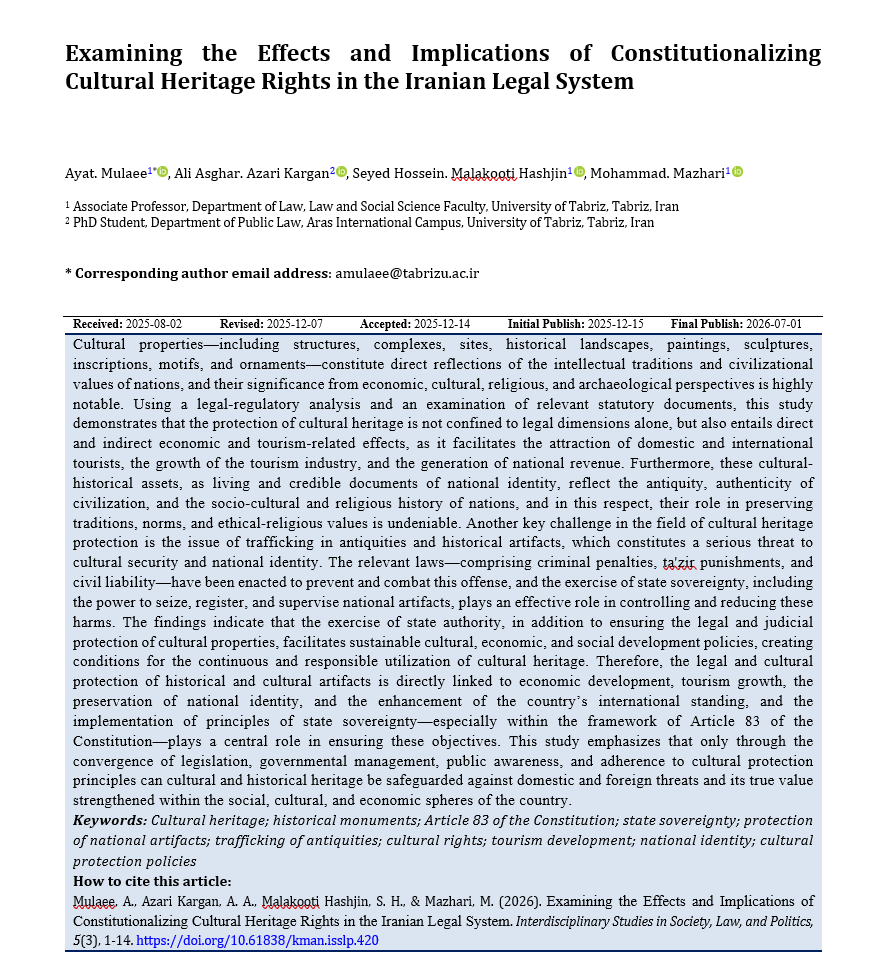
Cultural properties—including structures, complexes, sites, historical landscapes, paintings, sculptures, inscriptions, motifs, and ornaments—constitute direct reflections of the intellectual traditions and civilizational values of nations, and their significance from economic, cultural, religious, and archaeological perspectives is highly notable. Using a legal-regulatory analysis and an examination of relevant statutory documents, this study demonstrates that the protection of cultural heritage is not confined to legal dimensions alone, but also entails direct and indirect economic and tourism-related effects, as it facilitates the attraction of domestic and international tourists, the growth of the tourism industry, and the generation of national revenue. Furthermore, these cultural-historical assets, as living and credible documents of national identity, reflect the antiquity, authenticity of civilization, and the socio-cultural and religious history of nations, and in this respect, their role in preserving traditions, norms, and ethical-religious values is undeniable. Another key challenge in the field of cultural heritage protection is the issue of trafficking in antiquities and historical artifacts, which constitutes a serious threat to cultural security and national identity. The relevant laws—comprising criminal penalties, ta'zir punishments, and civil liability—have been enacted to prevent and combat this offense, and the exercise of state sovereignty, including the power to seize, register, and supervise national artifacts, plays an effective role in controlling and reducing these harms. The findings indicate that the exercise of state authority, in addition to ensuring the legal and judicial protection of cultural properties, facilitates sustainable cultural, economic, and social development policies, creating conditions for the continuous and responsible utilization of cultural heritage. Therefore, the legal and cultural protection of historical and cultural artifacts is directly linked to economic development, tourism growth, the preservation of national identity, and the enhancement of the country’s international standing, and the implementation of principles of state sovereignty—especially within the framework of Article 83 of the Constitution—plays a central role in ensuring these objectives. This study emphasizes that only through the convergence of legislation, governmental management, public awareness, and adherence to cultural protection principles can cultural and historical heritage be safeguarded against domestic and foreign threats and its true value strengthened within the social, cultural, and economic spheres of the country.
Downloads
References
Abbasi Lahiji, B. (2024). Cultural Heritage and Tourism Law.
Akbarzadeh, F. (2016). Iran's Criminal Law Approach to Cultural Heritage.
Blake, J. (2018). International Cultural Heritage Law. Oxford University Press.
Carstens, A. M. (2020). Intersections in International Cultural Heritage Law. https://doi.org/10.1093/oso/9780198846291.001.0001
Dolmetsch, F. (2019). Cultural Heritage and International Law. Springer.
Francioni, F., & Vrdoljak, A. F. (2020). The Oxford Handbook of International Cultural Heritage Law. Oxford University Press. https://doi.org/10.1093/law/9780198859871.001.0001
Khalilian, A. M. (1932). Cultural Properties in the Scope of Iran's Contemporary History. Cultural Heritage Journal(11), Autumn and Winter.
Merryman, J. H., & Elsen, A. (2018). Law, Ethics, and the Cultural Heritage. Stanford University Press.
Moradi, A. (2004). The Tourism Industry Needs a New Interpretation with a New View.
Prott, L. V., & O'Keefe, P. (2020). Law and the Cultural Heritage.
Samadi, Y., & Ansari, H. (2003). Cultural Heritage in Law: Domestic Law.
Simpson, E. (2017). International Cultural Property Protection: A Guide for Policymakers. Routledge.
Smith, L. (2015). Uses of Heritage. Routledge. https://doi.org/10.1007/978-1-4419-0465-2_1937
UNESCO. (2023). Database of National Cultural Heritage Laws (CultNatLaws). unesco.org
Downloads
Additional Files
Publication Timeline
- Submitted
- Revised
- Accepted
Issue
Section
License
Copyright (c) 2025 Ayat Mulaee (Corresponding author); Ali Asghar Azari Kargan, Seyed Hossein Malakooti Hashjin, Mohammad Mazhari (Author)

This work is licensed under a Creative Commons Attribution-NonCommercial 4.0 International License.