Opportunities and Challenges of Using Artificial Intelligence in the Pre-election Phase with an Emphasis on Iran's Legal and Electoral System
Keywords:
Artificial Intelligence, Digital Governance, Elections, Iranian Electoral System, Pre-election Phase, Public LawAbstract
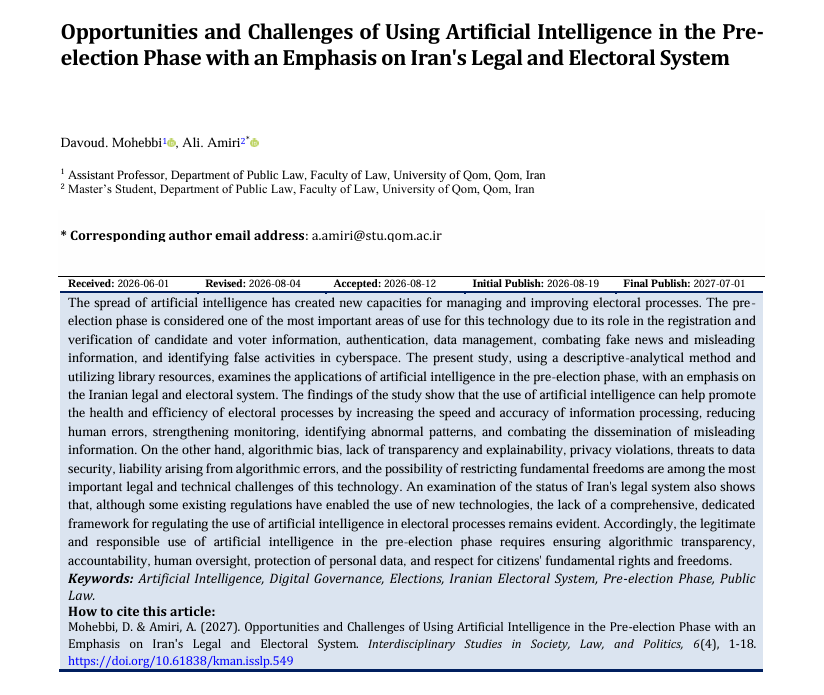
The spread of artificial intelligence has created new capacities for managing and improving electoral processes. The pre-election phase is considered one of the most important areas of use for this technology due to its role in the registration and verification of candidate and voter information, authentication, data management, combating fake news and misleading information, and identifying false activities in cyberspace. The present study, using a descriptive-analytical method and utilizing library resources, examines the applications of artificial intelligence in the pre-election phase, with an emphasis on the Iranian legal and electoral system. The findings of the study show that the use of artificial intelligence can help promote the health and efficiency of electoral processes by increasing the speed and accuracy of information processing, reducing human errors, strengthening monitoring, identifying abnormal patterns, and combating the dissemination of misleading information. On the other hand, algorithmic bias, lack of transparency and explainability, privacy violations, threats to data security, liability arising from algorithmic errors, and the possibility of restricting fundamental freedoms are among the most important legal and technical challenges of this technology. An examination of the status of Iran's legal system also shows that, although some existing regulations have enabled the use of new technologies, the lack of a comprehensive, dedicated framework for regulating the use of artificial intelligence in electoral processes remains evident. Accordingly, the legitimate and responsible use of artificial intelligence in the pre-election phase requires ensuring algorithmic transparency, accountability, human oversight, protection of personal data, and respect for citizens' fundamental rights and freedoms.
Downloads
References
Akbari, I., Vaezi, Aslipour, Abdolhosseinzadeh, Shahraini, & Seyed, M. (2024). Identifying and Modeling the Functions of Artificial Intelligence in Improving the Efficiency of the Administrative System and Providing Public Services. Iranian Public Administration Studies, 7(2), 111-147. https://doi.org/10.22034/jipas.2024.401497.1607
Bashir, & Ravi. (2025). A Systematic Review of Strategic Governance Frameworks and Mechanisms of Artificial Intelligence in Studies from 2017-2025. Cyberspace and Social Media Studies, 2(3), 9-54. https://doi.org/10.22083/cssms.2025.538964.1067
Binns, R. (2024). AI in Public Administration: Combating Corruption through Data Analytics. Journal of Technology and Law, 18(3), 77-94.
Brown, E., & Smith, R. (2023). Artificial Intelligence in Public Administration: International Experiences. Public Administration Review, 83(5), 1456-1468.
Brunner, E. (2026). Algorithmic Transparency as a Due Process Requirement in Automated Decision-Making. https://doi.org/10.2139/ssrn.5997154
Carvalho, A., & Rosa, L. (2024). Artificial Intelligence and Administrative Law: A New Paradigm. Cambridge AI Law Journal, 5(1), 55.
European, C. (2025). AI and Fundamental Rights: Regulatory Approaches in the EU.
Fatemi. (2024). Theoretical Approaches Governing the Determination of the Scope of the Right to Privacy and Its Impact on the Principles Governing the Right to Privacy in the Digital Space. Legal Research, e187404. https://doi.org/10.48300/jlr.2024.431431.2526
Fitzgerald, J. (2024). Privacy Concerns in the Use of AI for Anti-Corruption Efforts. International Journal of Privacy Law, 29(1), 55-70.
Foos, F. (2024). The Use of AI by Election Campaigns. LSE Public Policy Review, 3(3), 1-8. https://doi.org/10.31389/lseppr.112
Gonzalez, M., & Patterson, L. (2024). Regulating AI in Public Administration: Challenges and Policy Options. Journal of International Public Policy, 18(1), 23-41.
Habibi, H., & Homayoun. (2016). The Right to Privacy in Social Networks. Legal Research Quarterly, 19(75), 39-64.
Hassanbeigi, E. (2005). Law and Security in Cyberspace. Abrar Moaser International Studies and Research Cultural Institute.
Hekmatnia, M., Mohammadi, M., & Vathighi, M. (2019). Civil Liability Arising from the Production of Autonomous Artificial Intelligence-Based Robots. Islamic Law, 15(60), 231-255.
Hernandez, A. (2024). Ethical and Legal Challenges in AI-Driven Governance. Ethics and Technology Review, 11(2), 112-125.
Heydargholizadeh, Abedini, & Raisi. (2015). Privacy and the Obligation to Respect It in the Jurisprudence of the European Court of Human Rights. Islamic human rights studies, 8(4), 23-41.
Hosseinabadi, S., & Zarefard, M. (2022). Application of Artificial Intelligence in Electronic Surveillance and Increasing Transparency of Affairs.
Hosseini, M., Asiai, Faghih, L., & Farhang. (2025). Principles and Requirements of Exploiting the Capacity of Artificial Intelligence in Iranian Administrative Law and the Legal System of the European Union. Quarterly Scientific Research Journal of Administrative Law, 12(43), 43-75. https://doi.org/10.66224/qjal.12.43.43
Jabbari, M., & Karim, V. (2024). Legal Issues of Implementing Artificial Intelligence in Public Administration: A Case Study of Iran. International Journal of Administrative Law, 32(1), 78-92.
Jafari, & Rahbarpour. (2017). Civil Liability Arising from Data Privacy Violations in Imami Jurisprudence and Statutory Law. Private Law Research, 5(17), 43-74. https://doi.org/10.22054/jplr.2017.7404
Jalali Farahani, A. H., & Bagheri Asl, R. (2008). Social Prevention of Cybercrimes. Rahavard Noor Quarterly Journal of Information and Librarianship(24), 41-58.
Jasanoff, S. (2024). Data Privacy Laws and AI: A Global Review.
Kettunen, P., & Kallio, J. (2025). Smart State and the Integration of AI in Public Sector Decision-Making. International Review of Administrative Sciences, 91(2), 312-330.
Khosravi, Tayebitavkal, Mansourian, & Naserali. (2022). Challenges and Strategies of E-Government Towards Realizing Democracy. Contemporary Political Essays, 46(13), 59-83.
Liang, P. (2024). Social Credit Systems and AI-Based Governance in China: A Comparative Study. Harvard Law Review, 137(2), 320-345.
López-López, P. C., Barredo-Ibáñez, D., & Jaráiz-Gulías, E. (2023). Research on Digital Political Communication: Electoral Campaigns, Disinformation, and Artificial Intelligence. Societies, 13(5), 126. https://doi.org/10.3390/soc13050126
Mahmoudi, Akbari, & Iman. (2025). Governance of Artificial Intelligence (6): Application of Artificial Intelligence in Improving Public Services. https://doi.org/10.22034/report.mrc.2025.1404.33.3.20739
Martos, J. A. M. (2023). Inteligencia Artificial y Derechos de Participación Política. De Lege Ferenda(1), 34-55. https://doi.org/10.30827/dlf.1.2023.28552
Mehdi, A. (2025). An Analysis of the Challenges and Legal Solutions for Implementing Artificial Intelligence in the Iranian Administrative System. (42), 205-229.
Mohebbi, D., & Amiri, A. (2025). Legal and Ethical Challenges Related to the Use of Artificial Intelligence in the Administrative Justice System. Legal Studies in Digital Age, 4(1), 1-8. https://doi.org/10.61838/kman.lsda.549
Mostafavi Ardebili, S. M. M., Taghizadeh, A., Rahmatifar, & Samaneh. (2023). The Impact of Artificial Intelligence on the International Human Rights System. Law of New Technologies, 8(4), 86-100.
Muppasani, B., Pallagani, V., Lakkaraju, K., Lei, S., Srivastava, B., Robertson, B., & Narayanan, V. (2023). On Safe and Usable Chatbots for Promoting Voter Participation. Ai Magazine, 44(3), 240-247. https://doi.org/10.1002/aaai.12109
Mutawa, M. A., & Rashid, H. (2020). Comprehensive Review on the Challenges that Impact Artificial Intelligence Applications in the Public Sector Proceedings of the 5th NA International Conference on Industrial Engineering and Operations Management,
O'Neil, C. (2016). Weapons of Math Destruction: How Big Data Increases Inequality and Threatens Democracy. Crown Publishing Group.
Pavlidis, G., & Kastanas, I. (2026). Algorithmic Administration and the EU AI Act: Legal Principles for Public Sector Use of AI. https://doi.org/10.48550/arXiv.2604.22765
Rajaei, M., & Amiri, A. (2025). Public Law Challenges in Protecting Human Digital Rights in the Age of Artificial Intelligence. Legal Studies in Digital Age, 4(3), 1-7. https://doi.org/10.61838/kman.lsda.549
Schneider, J., & Klein, M. (2023). Legal Implications of Artificial Intelligence in Administrative Systems. Harvard Law Review, 139(4), 789-804.
Simoes, S., & MacCarthaigh, M. (2023). AI and Core Electoral Processes: Mapping the Horizons. https://doi.org/10.48550/arXiv.2302.03774
Susskind, R. (2024). Artificial Intelligence and the Rule of Law. Oxford University Press.
Takhtaei, B. (2011). Analysis of End-to-End Electronic Voting Systems Sharif University of Technology].
Tavakoli-Rad, R., & Sadat Miri, H. (2021). Governance Transformation: From E-Government to Digital Governance. Journal of Transcendental Governance, 2(3), 115-162.
Wang, Y., & Lee, M. (2023). Artificial Intelligence in Judicial Systems: A Global Perspective. International Journal of Law and Technology, 11(3), 90-108.
Wieringa, M. (2020). What to Account for When Accounting for Algorithms: A Systematic Literature Review on Algorithmic Accountability Proceedings of the 2020 Conference on Fairness, Accountability, and Transparency, https://doi.org/10.1145/3351095.3372833
Zakirinia, H. (2023). The Nature and Basis of Civil Liability Arising from Artificial Intelligence in Iranian and European Union Law. Journal of Private Law, 20(1), 135-152. https://doi.org/10.22059/jolt.2023.356703.1007186
Downloads
Additional Files
Publication Timeline
- Submitted
- Revised
- Accepted
Issue
Section
License
Copyright (c) 2025 Davoud Mohebbi (Author); Ali Amiri (Corresponding author)

This work is licensed under a Creative Commons Attribution-NonCommercial 4.0 International License.