State Obligations in Realizing Freedom of Movement and the Human Right to Mobility
Keywords:
right to freedom of movement (mobility), state obligations, human rightsAbstract
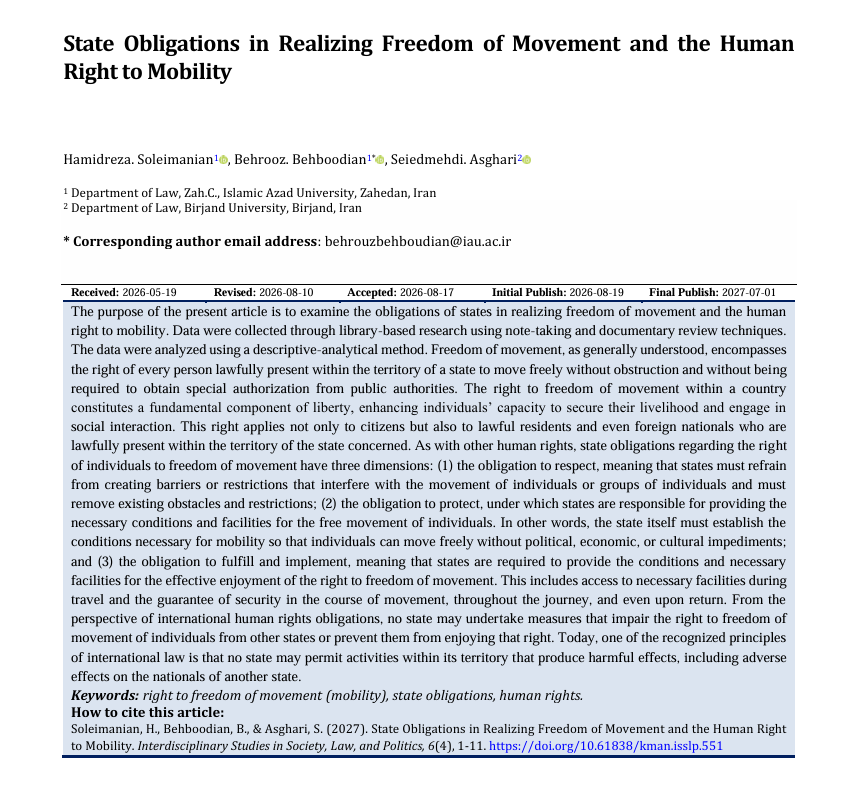
The purpose of the present article is to examine the obligations of states in realizing freedom of movement and the human right to mobility. Data were collected through library-based research using note-taking and documentary review techniques. The data were analyzed using a descriptive-analytical method. Freedom of movement, as generally understood, encompasses the right of every person lawfully present within the territory of a state to move freely without obstruction and without being required to obtain special authorization from public authorities. The right to freedom of movement within a country constitutes a fundamental component of liberty, enhancing individuals’ capacity to secure their livelihood and engage in social interaction. This right applies not only to citizens but also to lawful residents and even foreign nationals who are lawfully present within the territory of the state concerned. As with other human rights, state obligations regarding the right of individuals to freedom of movement have three dimensions: (1) the obligation to respect, meaning that states must refrain from creating barriers or restrictions that interfere with the movement of individuals or groups of individuals and must remove existing obstacles and restrictions; (2) the obligation to protect, under which states are responsible for providing the necessary conditions and facilities for the free movement of individuals. In other words, the state itself must establish the conditions necessary for mobility so that individuals can move freely without political, economic, or cultural impediments; and (3) the obligation to fulfill and implement, meaning that states are required to provide the conditions and necessary facilities for the effective enjoyment of the right to freedom of movement. This includes access to necessary facilities during travel and the guarantee of security in the course of movement, throughout the journey, and even upon return. From the perspective of international human rights obligations, no state may undertake measures that impair the right to freedom of movement of individuals from other states or prevent them from enjoying that right. Today, one of the recognized principles of international law is that no state may permit activities within its territory that produce harmful effects, including adverse effects on the nationals of another state.
Downloads
References
Aghaei, B. (2017). Dictionary of Human Rights (6th ed.). Ganj-e Danesh Library.
Amid Zanjani, A. A., & Tavakoli, M. M. (2017). Islamic Human Rights and the Inherent Dignity of the Human Person in Islam. Hoghoogh: Journal of the Faculty of Law and Political Science(4).
Ashouri, D. (2016). Political Encyclopedia: A Dictionary of Political Terms and Schools (5th ed.). Morvarid Publications.
Ashouri, M. (2016). Human Rights and the Concepts of Equality, Equity, and Justice (4th ed.). Faculty of Law and Political Science, University of Tehran.
Barnett, E. (2013). An Introduction to Constitutional Law (3rd ed.). Mizan.
Baubock, R. (2012). Free Movement and Asymmetry Between Exit and Entry. Sweet and Maxwell.
Blakely, G. L., Andrews, M. C., & Moorman, R. H. (2009). The Moderating Effects of Equity Sensitivity on the Relationship Between Organizational Justice and Organizational Citizenship Behaviors. Journal of Business and Psychology, 25.
Boushehri, J. (2017). Issues in Constitutional Law (4th ed.). Dadgostar.
Esmaeili, M., & Amini Pazouh, H. (2016). Analysis of the Nature and Legal Regime Governing State Obligations under the International Covenant on Economic, Social and Cultural Rights and the Constitution of the Islamic Republic of Iran. Quarterly Journal of Public Law Knowledge, 5(14).
Ghazi, S. A. (2019). Essentials of Constitutional Law (30th ed.). Mizan.
Ghorbannia, N. (2018). Human Rights and Humanitarian Law. Research Institute for Islamic Culture and Thought.
Gill, G. (2008). International Law and the Movement of Persons Between Status. Oxford University Press.
Grahl, M. (2002). Unspecified Work. (pp. 209).
Hicks, N. (2013). The Impact of Counter Terror on the Promotion and Protection of Human Rights. Cambridge University Press.
Hurat, H. (2005). The Right to Leave and Reters in International Law and Practies. (pp. 196): Macti.
Kamalan, S. M. (2019). Charter of the United Nations (4th ed.). Kamalan Publications.
Madani, S. J. a.-D. (2015). Comparative Constitutional Law (6th ed.). Ganj-e Danesh Library.
Madani, S. J. a.-D. (2017). Constitutional Law and Political Institutions (10th ed.). Ganj-e Danesh.
Majandeh, M. M. (2015). Philosophical Foundations of Human Rights. Nameh-ye Mofid(2).
McCrudden, C. (2017). Human Dignity and Judicial Interpretation of Human Rights. Khorsandi Publishing.
Mirarab, M. (2018). A Brief Look at the Concept of Security. Quarterly Journal of Political Science, 3(9).
Moghaddasi, Y., & Yahyaei, H. (2016). Analysis of the Fourth Generation of Human Rights and Its Role in Protecting Human Dignity. University Research Publications.
Molaei, A. (2000). Human Rights and National Sovereignty. Political-Economic Information(155-156).
Nasri Meshkini, G. (2018). Security Studies Approaches in the Middle East. Quarterly Journal of Strategic Studies(20).
Rahmani, E., & Moezeni, S. (2016). The Status of Human Dignity in the Constitution of the Islamic Republic of Iran. Quarterly Journal of Development Strategy(48).
Shariati, S. (2018). The Rights of the Nation and the State in the Constitution (5th ed.). Kanoon Andisheh Javan.
Shelton, D. (2011). Regional Protection of Human Rights. Oxford University Press.
Ston, R. (2012). Human Rights Transformed: Positive Rights and Positive Duties. Oxford University Press.
Stout, J. (2012). Democracy and Tradition. Princeton University Press.
Tabatabaei Motameni, M. (2019). Public Freedoms and Human Rights (6th ed.). University of Tehran Press.
Vafadar, A. (2017). Constitutional Law and Political Developments (6th ed.). Sharvin Publications.
Downloads
Additional Files
Publication Timeline
- Submitted
- Revised
- Accepted
Issue
Section
License
Copyright (c) 2025 Hamidreza Soleimanian (Author); Behrooz Behboodian (Corresponding author); Seiedmehdi Asghari (Author)

This work is licensed under a Creative Commons Attribution-NonCommercial 4.0 International License.