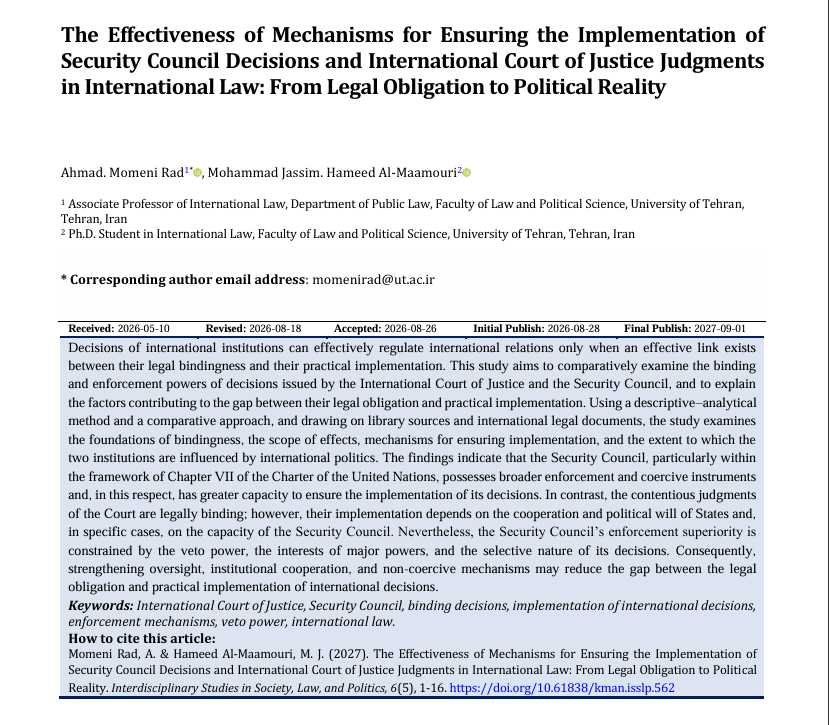
The Effectiveness of Mechanisms for Ensuring the Implementation of Security Council Decisions and International Court of Justice Judgments in International Law: From Legal Obligation to Political Reality
Keywords:
International Court of Justice, Security Council, binding decisions, implementation of international decisions, enforcement mechanisms, veto power, international lawAbstract
Decisions of international institutions can effectively regulate international relations only when an effective link exists between their legal bindingness and their practical implementation. This study aims to comparatively examine the binding and enforcement powers of decisions issued by the International Court of Justice and the Security Council, and to explain the factors contributing to the gap between their legal obligation and practical implementation. Using a descriptive–analytical method and a comparative approach, and drawing on library sources and international legal documents, the study examines the foundations of bindingness, the scope of effects, mechanisms for ensuring implementation, and the extent to which the two institutions are influenced by international politics. The findings indicate that the Security Council, particularly within the framework of Chapter VII of the Charter of the United Nations, possesses broader enforcement and coercive instruments and, in this respect, has greater capacity to ensure the implementation of its decisions. In contrast, the contentious judgments of the Court are legally binding; however, their implementation depends on the cooperation and political will of States and, in specific cases, on the capacity of the Security Council. Nevertheless, the Security Council’s enforcement superiority is constrained by the veto power, the interests of major powers, and the selective nature of its decisions. Consequently, strengthening oversight, institutional cooperation, and non-coercive mechanisms may reduce the gap between the legal obligation and practical implementation of international decisions.
Downloads
References
Abedi, M., & Amini, A. (2019). Mechanisms for guaranteeing implementation of provisional measures of the International Court of Justice. Quarterly Journal of Strategic Studies, 22(2), 135-163.
Abu Amoud, M. S. (2013). Contemporary international relations. Dar al-Maaref Establishment.
Aidonojie, P. A., Ismiala, H. A., Antai, G. O., Ekspenisi, C., & Obieshi, E. (2026). Legal implications of the P5 veto power on the enforcement of ICJ judgments and its impact on the credibility of the UN Security Council. Sinergi International Journal of Law, 4(1), 42-56.
Aidonojie, P. A., Mulegi, T., Jufri, M., Imiefoh, A. I., & Antai, G. O. (2024). International laws regulating human rights in business operations in Uganda: Issues and challenges. Fenomena, 23(2), 131-144.
Aidonojie, P. A., Wakili, S. A., & Ayuba, D. (2023). Effectiveness of the administration of justice in Nigeria under the development of digital technologies. Journal of Digital Technologies and Law, 1(4), 1105-1131.
Akram, S. (2023). Jus cogens limits on the veto power: A case study of Palestine-Israel conflict.
Al-Tabbal, H. M. (2010). International and regional conventions on personal security. Modern Book Institution.
Allen, S. H. (2024). As time goes by: Action in the UN Security Council. Oxford University Press.
Almakky, R. (2023). The role of international organisations in the development of international law: An analytical assessment of the United Nations. Law and World, 9(28), 40-66.
Aminzadeh, F., & Hadi, V. (1998). A legal examination of restructuring the United Nations Security Council. Events and Analyses(122).
Bahiru, B. A. (2022). Challenges of dispute settlement through International Court of Justice (ICJ): The case of Ukraine v. Russian Federation and the decision on provisional measures on alleged violation of the Genocide Convention. European scientific journal, 18(29), 64-84.
Baidwain, J. S. (2023). Preventing genocide: Promoting the implementation of the third pillar of R2P by restraining the veto power of P5.
Bellamy, A. J. (2016). Global politics and the responsibility to protect: From words to deeds. Routledge.
Bernstorff, J. (2008). Procedures of decision-making and the role of law in international organizations. German Law Journal, 9(1), 1939-1950.
Couzigou, I. (2017). Enforcement of UN Security Council resolutions and of International Court of Justice judgments: The unreliability of political enforcement mechanisms. In The Enforcement of EU Law and Values: Ensuring Member States' Compliance. Oxford University Press.
D'Alessandra, F. (2024). Conceptualizing great power perpetrators. Genocide Studies and Prevention, 18(1), 1-18.
Dixon, M., McCorquodale, R., & Williams, S. (2024). Cases & materials on international law (7th ed.). Oxford University Press.
Ezra, G. (2022). Reflections on the law-making powers of the Security Council. In The Security Council as Global Legislator (pp. 55-72). Naval War College Press.
Falij, M. (2024). Effective mechanisms for implementing International Court of Justice judgments issued against the Zionist entity. Journal of Legal and Juridical Studies, 1(29).
Forsythe, D. P. (2012). The UN Security Council and response to atrocities: International criminal law and the P-5. Human Rights Quarterly, 34(3), 840-863.
Ghorbanipour, M., Raeisi, L., & Rostamzad, H. (2023). Legitimacy of the ICJ's actions in developing international law rules. Tehran University Public Law Quarterly, 53(3), 1293-1315.
Gowan, R. (2018). Minimum order: The role of the Security Council in an era of major power competition.
Guillaume, G. (1996). Enforcement of decisions of the International Court of Justice. In Perspectives on International Law. Kluwer Law International.
Helaliannejad, S. (2021). An examination of the doctrine of the unlimited jurisdiction of the Security Council Payame Noor University, Khuzestan Province, Dezful Center].
Hermawanto, A., & Heriningsih, S. (2025). Veto and the UN Security Council's failure to resolve the Israeli-Palestinian conflict. Management and Social Sciences, 5(2), 140-156.
Iwasawa, Y., & Rezaei Asrami, M. (2025). Diverse mechanisms for the application and implementation of international law. Legal Civilization, 8(24), 449-474.
Jadaliyya. (2024). The International Court of Justice or the International Criminal Court: Which can help in the Palestinian case?
Jedi Rahim Biglow, S., Yahyizadeh, Y., & Hajitabar, H. (2026). Examining the enforcement of judgments issued by international courts. Comparative Studies in Jurisprudence, Law, and Politics, 8(2), 1-16.
Khaldi, A., & Hamza, A. (2024). The influence of permanent members of the Security Council on international peace and security: The necessity for structural reforms in light of the Gaza crisis. Russian Law Journal, 12(2), 1402-1412.
Klabbers, J. (2015). Advanced introduction to the law of international organizations. Edward Elgar.
Krisch, N. (2012). Article 39. In The Charter of the United Nations (3rd ed.). Oxford University Press.
Legal Research, C. (2023). The contribution of the International Court of Justice to the management of contemporary international crises [Published research paper].
Mirabbasi, S. B. (1984). A brief examination of the jurisdiction of the International Court of Justice at The Hague. International Legal Journal, 1(1).
Murphy, S. D. (2015). Reflections on the ICJ advisory opinion on Kosovo. In The Law and Politics of the Kosovo Advisory Opinion (pp. 145-159). Oxford University Press.
O'Connell, M. E. (2023). The United Nations Security Council's implementation of the responsibility to protect: Review of past. Chicago Journal of International Law, 23(1), 76-112.
Palchetti, P. (2017). Responsibility for breach of provisional measures of the ICJ: Between protection of the rights of the parties and respect for the judicial function. Rivista di diritto internazionale, 1(1).
Pay, V. N. (2022). Power and diplomacy in the United Nations Security Council. International Studies in Asia and Global Security Quarterly, 4(3), 201-221.
Punzi, C. (2024). New technologies and AI: Envisioning future directions for UNSCR 1540. Journal of International Security.
Qassem, A. N. (2023). Impact of the supervisory role of the International Court of Justice on Security Council resolutions. Al-Kitab Journal for Human Sciences, 4(6), 25-38.
Robinson, M., Jones, K., Janicke, H., & Maglaras, L. (2017). An introduction to cyber peacekeeping. International Peacekeeping & Tech Review, 3(1), 5-22.
Robinson, M., Jones, K., Janicke, H., & Maglaras, L. (2018). Developing cyber buffer zones. Cyber Peacekeeping Review, 12, 33-48.
Scott, S. V., & Chase, M. (2022). International law in world politics: An introduction (4th ed.). Lynne Rienner Publishers.
Seifzadeh, F., Zamani, S. G., Savari, H., & Raei Dehqhi, M. (2017). An examination of the Security Council's mission in applying the responsibility to protect doctrine. Comparative Law Research, 21(1).
Seyed Jalili Saqqezchi, M. M. (2025). Development and codification of private international law within the framework of the Hague Conference Organization. Studies in Political Science, Law, and Jurisprudence, 11(1).
Shamsutdinov, I. R. (2026). The role of the UN in ensuring the enforcement of the decisions of the International Criminal Court. International Law, 1(1), 1-15.
Subramanian, R. S. (2022). UN Security Council and human rights: An inquiry into the legal foundations of the responsibility to protect in international law. Utrecht Journal of International and European Law, 37(1), 20-40.
Tabatabaei, S. A. (2012). The Security Council and military intervention in Libya: Protection of civilians and establishment of a no-fly zone. Private Law Journal, 7(89).
Trahan, J. (2020). Existing legal limits to Security Council veto power in the face of atrocity crimes. Cambridge University Press.
Tzevelekos, V. P. (2017). Human security and shared responsibility to fight transnational crimes: Resolution 2240 (2015) of the UN Security Council on smuggling of migrants. In Blurring Boundaries: Human Security and Forced Migration (pp. 201-220). Brill Nijhoff.
United, N. (1945). Charter of the United Nations. United Nations
Ušiak, J., & Saktorova, L. (2022). The International Court of Justice and the legality of UN Security Council resolutions. Danube, 5(3), 201-212.
Wu, E. C. T. (2019). The legality of unilateral declaration of independence in international law: Analysis of the Kosovo advisory opinion of the ICJ [Doctoral dissertation, National Chengchi University].
Zakarhossein, M. H. (2022). Prosecutor's powers in initiating the preliminary examination process in the International Criminal Court. Justice Law Journal, 86(117), 59-81.
Zaman, N., Aidonojie, P. A., Jufri, M., & Jackson-Ortiz, R. D. (2024). Questioning the constitutional court decision regarding age limit of presidential and vice-presidential candidates. Petita: Jurnal Kajian Ilmu Hukum Dan Syariah, 9(2), 1-15.
Downloads
Additional Files
Publication Timeline
- Submitted
- Revised
- Accepted
Issue
Section
License
Copyright (c) 2025 Ahmad Momeni Rad (Corresponding author); Mohammad Jassim Hameed Al-Maamouri (Author)

This work is licensed under a Creative Commons Attribution-NonCommercial 4.0 International License.