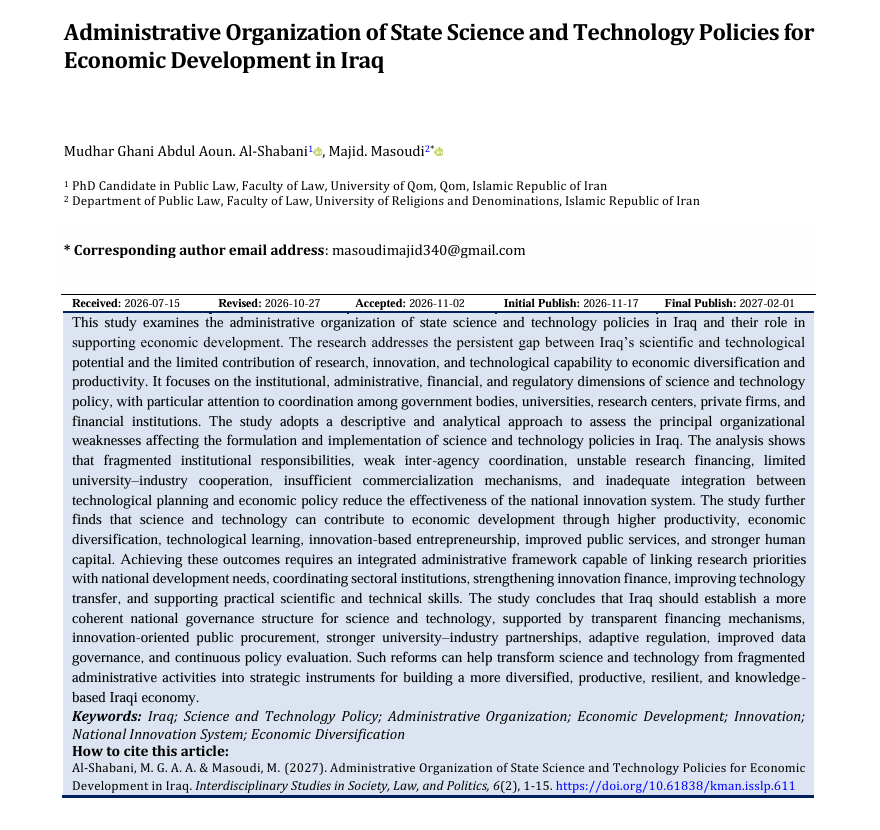
Administrative Organization of State Science and Technology Policies for Economic Development in Iraq
DOI:
https://doi.org/10.61838/kman.isslp.611Keywords:
Iraq, Science and Technology Policy, Administrative Organization, Economic Development, Innovation, National Innovation System, Economic DiversificationAbstract
This study examines the administrative organization of state science and technology policies in Iraq and their role in supporting economic development. The research addresses the persistent gap between Iraq’s scientific and technological potential and the limited contribution of research, innovation, and technological capability to economic diversification and productivity. It focuses on the institutional, administrative, financial, and regulatory dimensions of science and technology policy, with particular attention to coordination among government bodies, universities, research centers, private firms, and financial institutions. The study adopts a descriptive and analytical approach to assess the principal organizational weaknesses affecting the formulation and implementation of science and technology policies in Iraq. The analysis shows that fragmented institutional responsibilities, weak inter-agency coordination, unstable research financing, limited university–industry cooperation, insufficient commercialization mechanisms, and inadequate integration between technological planning and economic policy reduce the effectiveness of the national innovation system. The study further finds that science and technology can contribute to economic development through higher productivity, economic diversification, technological learning, innovation-based entrepreneurship, improved public services, and stronger human capital. Achieving these outcomes requires an integrated administrative framework capable of linking research priorities with national development needs, coordinating sectoral institutions, strengthening innovation finance, improving technology transfer, and supporting practical scientific and technical skills. The study concludes that Iraq should establish a more coherent national governance structure for science and technology, supported by transparent financing mechanisms, innovation-oriented public procurement, stronger university–industry partnerships, adaptive regulation, improved data governance, and continuous policy evaluation. Such reforms can help transform science and technology from fragmented administrative activities into strategic instruments for building a more diversified, productive, resilient, and knowledge-based Iraqi economy.
Downloads
References
Abd al-Rahim, A.-H. A.-Z. M. (2023). Informational, Broadcasting, and Political Sovereignty from the Perspective of Legal Capacity: An Extracted Study. Journal of Jurisprudence and Law.
Al-Douri, H. A. M. A. (2022). The Impact of Technological Developments on the Right to Privacy. Journal of the College of Law for Legal and Political Sciences.
Al-Khatib, M. I. (2020). Artificial Intelligence and Law: Toward a Legislative Framework for Artificial Intelligence within the Framework of European Rules. Legal and Judicial Journal.
Ali, H. (2025). Integrating Artificial Intelligence into Research Methodology: A Study of Potential Bias and Mitigation Strategies. Arab Journal for Quality Assurance in University Education.
Chakour, R. J. (2024). The Impact of Artificial Intelligence on the Future of the International System. Journal of the College of Law for Legal and Political Sciences.
Dagher, S. M. (2023). Civil Liability for Robot-Related Damage: A Comparative Study [Master's thesis, University of Maysan, College of Law, Department of Private Law].
Darwish, R. M. A. (2020). Freedom of Information Circulation in the Context of the Information Imbalance: A Case Study of Press and Internet Laws. Scientific Journal of the Faculty of Arts.
Dhiya, K. H. (2024). Legal Confrontation of Criminal Acts Using Artificial Intelligence: Property Rights as a Model. Al-Muhaqqiq al-Hilli Journal of Legal and Political Sciences.
Hassan, M. J. I. (2024). The Ethics of Applying Artificial Intelligence from a Legal Perspective: An Analytical and Prospective Study. Journal of Jurisprudence and Law.
Jabour, Z. M. (2022). The Right to Knowledge and Access to Information in Iraqi and Comparative Legislation. Journal of Legal Sciences.
Jafri, M. (2021). Information and Legal Security in Electronic Administrative Contracts. Qanounak Journal.
Karim, S. A. (2022). The Legal Regulation of Artificial Intelligence: A Comparative Study [Doctoral dissertation, University of Karbala, College of Law].
Kouzi, A. (2022). Protection of Privacy in the Information Age and the Challenges of Artificial Intelligence. Journal of Law and Business.
Kouzi, O. B. (2024). Judicial Oversight of Intellectual Property in the Information Technology Field. Journal of Legal Guidance.
Downloads
Additional Files
Publication Timeline
- Submitted
- Revised
- Accepted
Issue
Section
License
Copyright (c) 2025 Mudhar Ghani Abdul Aoun Al-Shabani (Author); Majid Masoudi (Corresponding author)

This work is licensed under a Creative Commons Attribution-NonCommercial 4.0 International License.