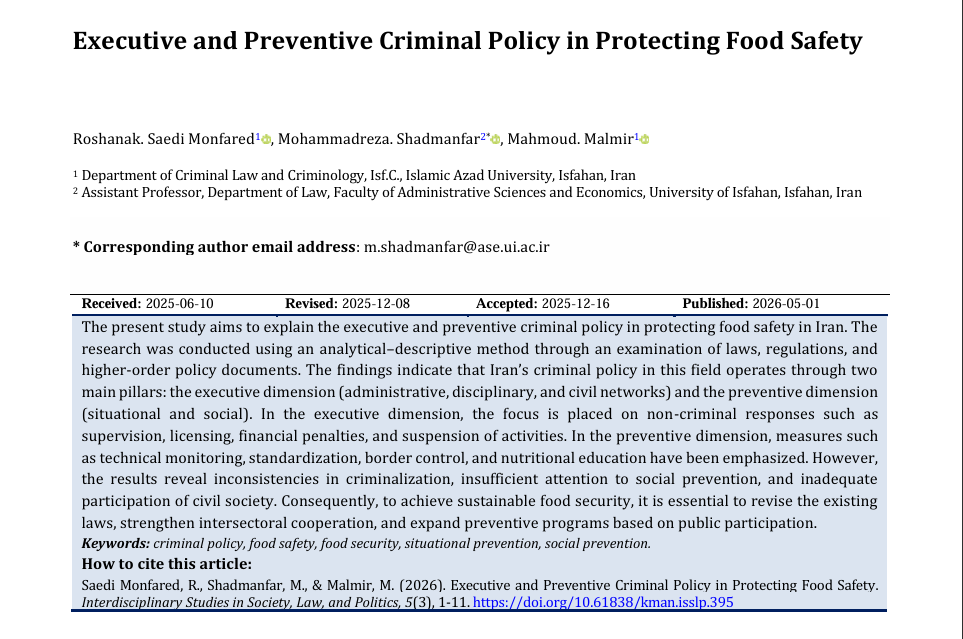
Executive and Preventive Criminal Policy in Protecting Food Safety
Keywords:
Legislative criminal policy, food safety, food security, situational prevention, social preventionAbstract
The present study aims to explain the executive and preventive criminal policy in protecting food safety in Iran. The research was conducted using an analytical–descriptive method through an examination of laws, regulations, and higher-order policy documents. The findings indicate that Iran’s criminal policy in this field operates through two main pillars: the executive dimension (administrative, disciplinary, and civil networks) and the preventive dimension (situational and social). In the executive dimension, the focus is placed on non-criminal responses such as supervision, licensing, financial penalties, and suspension of activities. In the preventive dimension, measures such as technical monitoring, standardization, border control, and nutritional education have been emphasized. However, the results reveal inconsistencies in criminalization, insufficient attention to social prevention, and inadequate participation of civil society. Consequently, to achieve sustainable food security, it is essential to revise the existing laws, strengthen intersectoral cooperation, and expand preventive programs based on public participation.
Downloads
References
Almond, G. A., & Powell, B. G. (2001). Citizen Participation and Political Presence. Political-Economic Information Magazine(164).
Asghari, M. (2018). Rishveh va Ehtekār (Bribery and Hoarding). Ettela'at Publications.
Ashtariān, K. (2017). Siyāsat Gozāri-ye 'Omūmi-ye Irān (Public Policy Making in Iran). Mizan Legal Foundation.
Bandariyān, R. (2009). Marketing and Commercialization of New Technologies: Stages, Facilitating Factors, and Key Success Factors. Specialized Quarterly of Parks and Growth Centers(19).
Beygdelī, S., & Badi' Sanāye' Isfahani, A. (2014). The Basis of Civil Liability Arising from Genetically Modified Food Products. Comparative Law Studies(5).
Darvīshī Hoveydā, Y. (2011). A Study on Mediation as a Friendly Method of Dispute Resolution. Quarterly Journal of Private Law Studies, 41(4).
Habībnejād, S. A., & Sa'īd, S. Z. (2017). The Necessity of Transition from "Obligation of Means" to "Obligation of Result" in the Interpretation of Article 3 of the Constitution. Journal of Islamic Law(53).
Heydarī, I. (2017). The Foundations and Legal Status of Compensation for Unjustified Detention in Iranian Criminal Procedure. Journal of Criminal Law Research, 8(1).
Hoseinvand, M. (2022). Miyānjīgarī-ye Keyfarī dar Partow-e Āmūzehā-ye 'Adālat Tarmīmī (Criminal Mediation in Light of Restorative Justice Teachings). Majd Publications.
Hosseini, S. H., & Ahmadi, Z. (2014). The Criminal Policy of the Law on the Implementation of the General Policies of Article 44 of the Constitution. Economic Law Encyclopedia, New Series, 21(5).
Jahānī, B., & Khāleghī, M. (2021). The Criminalization of Hoarding in Line with Consumer Rights Protection. Ta'āli Hoghooghi (Legal Excellence)(16 & 17).
Jamshīdī, A. (2019). Prevention of Economic Crimes: From Judicial Measures to Executive Measures. Collection of Speeches from the First National Conference on Crime Prevention, Tehran.
Marty, D. (2016). Nizāmhā-ye Bozorg-e Siyāsat-e Jenā'ī (Major Systems of Criminal Policy) (Translated by A. H. Najafī Abrandābādī. 2nd ed.). Mizan.
Moqaddasī, R. (2019). Estrātezhī Dastyābī be Amniyat-e Ghază'ī (Strategy for Achieving Food Security). Research Center of the Parliament, Office of Infrastructure Studies.
Mubīnī Dehkordī, A. (2004). The Process of Compiling and Presenting the Optimal Food Security Strategy of the Islamic Republic of Iran. Strategic Defense Studies Quarterly(19).
Pour Esmā'īlī, A., & et al. (2017). A Comparative Study of Transgenic Product Consumers in Iran and the European Union. Journal of Bioethics, 7(24).
Qārī Sayyed Fāṭemī, S. M., & Reẓā'īān, S. (2018). Government Liability for Citizens' Intellectual Property Rights and Food Security. Quarterly Journal of Judicial Sciences Research, 23(83).
Rahbari, E. (2015). A Comparative Study of the Role of Financial Penalties in Implementing Competition Rules. Comparative Law Studies, 6(1).
Rahbari, E. (2016). A Comparative Study of Binding Decisions of Competition Authorities. Comparative Law Research, 20(1).
Rahīmī Badr, B. (2017). Prioritization of Selected Agricultural Products with the Aim of Meeting Demand in the 2025 Development Horizon. Agricultural Economics and Development, 25(97).
Rahnemā, H. (2015). A Comparative Review of Different Religions' Views on Transgenic Products Technology. Quarterly Journal of Bioethics, 5(16).
Rāsekh, M., & Āmeri, F. (2013). A Theoretical Approach to the Concept of Third Generation Rights. Public Law Research, 15(39).
Sā'ed, M. J. (2014). Hoghoog-e Keyfari va Akhlāq-e Zīstī (Criminal Law and Bioethics). Danesh Shahr.
Saffārī, A., & Ijtehādī, S. A. (2017). Differentiated Criminal Policy Towards the Smuggling of Health-Oriented Goods. Quarterly Journal of Police Knowledge Research, 19.
Sen, A. (2011). The Idea of Justice (Translated by H. Homāyounpour and V. Maḥmūdī. 1st ed.). Kand o Kāb Publications.
Shahrī, G. R., & et al. (2017). Majmū'e Tanqīḥ Shodeh-ye Qawānīn va Moqarrarāt-e Keyfarī (Revised Collection of Criminal Laws and Regulations). Official Gazette of the Country.
Tājīk, M. (2012). Moqaddameh'i bar Estrātezhīhā-ye Mellī-ye Jomhūrī-ye Eslāmi-ye Irān (An Introduction to the National Strategies of the Islamic Republic of Iran) (Vol. 1). Farhang-e Goftemān Publishing.
Tavakkolī, A. R., & Ḥaqshnās, M. R. (2014). Crimes Against Public Health from the Perspective of Comparative Jurisprudence and Criminal Law with Emphasis on the Crime of Adulteration in Foodstuffs. Bi-quarterly Journal of Comparative Jurisprudence, 2(3).
Zamānī, S. G., & Gharīb Ābādī, K. (2017). Sanctions as a Violation of States' International Obligations Regarding the Protection of Human Rights. Quarterly Journal of Medical Law, 11(40).
Downloads
Additional Files
Publication Timeline
- Submitted
- Revised
- Accepted
Issue
Section
License
Copyright (c) 2026 Roshanak Saedi Monfared, Mohammadreza Shadmanfar, Mahmoud Malmir (Author)

This work is licensed under a Creative Commons Attribution-NonCommercial 4.0 International License.