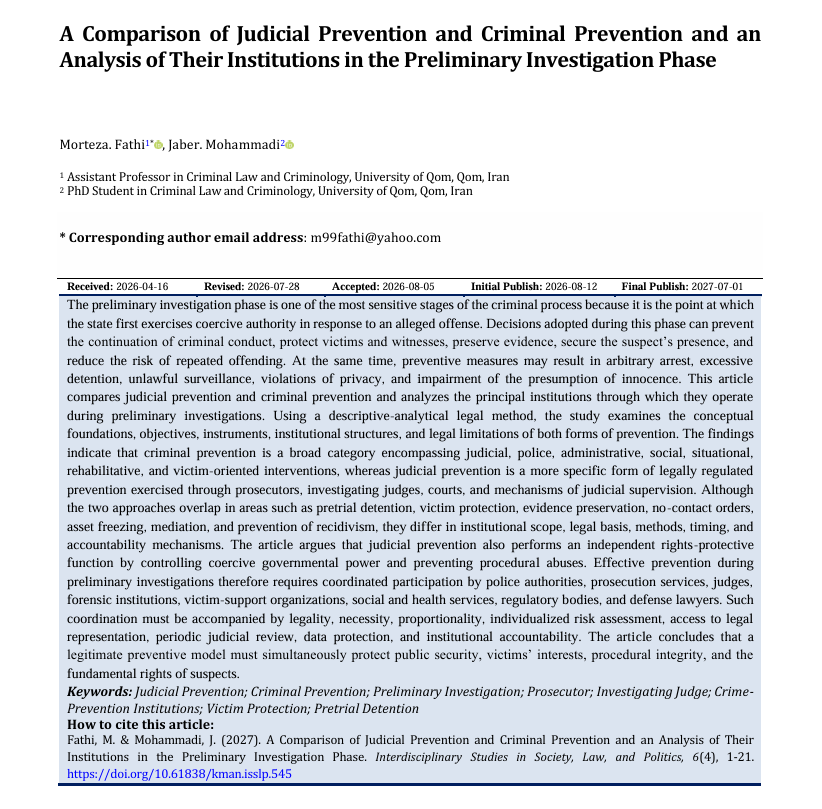
A Comparison of Judicial Prevention and Criminal Prevention and an Analysis of Their Institutions in the Preliminary Investigation Phase
Keywords:
prevention, judicial measures, judicial prevention, criminal prevention, preventive proceedingsAbstract
The preliminary investigation phase is one of the most sensitive stages of the criminal process because it is the point at which the state first exercises coercive authority in response to an alleged offense. Decisions adopted during this phase can prevent the continuation of criminal conduct, protect victims and witnesses, preserve evidence, secure the suspect’s presence, and reduce the risk of repeated offending. At the same time, preventive measures may result in arbitrary arrest, excessive detention, unlawful surveillance, violations of privacy, and impairment of the presumption of innocence. This article compares judicial prevention and criminal prevention and analyzes the principal institutions through which they operate during preliminary investigations. Using a descriptive-analytical legal method, the study examines the conceptual foundations, objectives, instruments, institutional structures, and legal limitations of both forms of prevention. The findings indicate that criminal prevention is a broad category encompassing judicial, police, administrative, social, situational, rehabilitative, and victim-oriented interventions, whereas judicial prevention is a more specific form of legally regulated prevention exercised through prosecutors, investigating judges, courts, and mechanisms of judicial supervision. Although the two approaches overlap in areas such as pretrial detention, victim protection, evidence preservation, no-contact orders, asset freezing, mediation, and prevention of recidivism, they differ in institutional scope, legal basis, methods, timing, and accountability mechanisms. The article argues that judicial prevention also performs an independent rights-protective function by controlling coercive governmental power and preventing procedural abuses. Effective prevention during preliminary investigations therefore requires coordinated participation by police authorities, prosecution services, judges, forensic institutions, victim-support organizations, social and health services, regulatory bodies, and defense lawyers. Such coordination must be accompanied by legality, necessity, proportionality, individualized risk assessment, access to legal representation, periodic judicial review, data protection, and institutional accountability. The article concludes that a legitimate preventive model must simultaneously protect public security, victims’ interests, procedural integrity, and the fundamental rights of suspects.
Downloads
References
Abaachi, M. (2004). Prevention of Juvenile Delinquency and Victimisation. Judicial Law Journal(47), 65-85.
Abbasian, A., & Alipour, H. (2015). Capacities for Generalising the Institution of Charge Bargaining to Iran's Criminal System. Comparative Law Studies, 6(2).
Amiri, S., & Roohalamini, M. (2017). A Study of Practical Approaches to the Role of the Prosecutor in Crime Prevention. New Research in Humanities(21).
Ashouri, M. (2003). Human Rights: Concepts of Equality, Fairness and Justice—Critiques. University of Tehran.
Ebrahimi, S. (2009). Broad and Narrow Approaches to Prevention and Their Effects on Legal Doctrines. Journal of Razavi University of Islamic Sciences(12).
Ebrahimi, S. (2022). Fair Rehabilitation of Offenders and Criminal Law Doctrines. Criminal law doctrines(3), 39-60.
Koosha, J. (2010). The Role of the Judiciary in Crime Prevention. In Collected Papers of the Scientific-Applied Conference on Crime Prevention of the Judiciary (1st ed., Vol. 1). Publications of the General Justice Department of Khorasan Razavi Province.
Miri, S., & Roohalamini, M. (2017). A Study of Practical Approaches to the Role of the Prosecutor in Crime Prevention. New Research in Humanities(21), 150-170.
Mirkhalili, S. M. (2004). Situational Prevention from the Perspective of Islamic Teachings. Journal of Jurisprudence and Law, 1(51).
Mirkhalili, S. M., & Rahimi, J. (2012). Criminal Prevention of Repeat Victimisation. Islamic Law(124), 70-90.
Moazenzadegan, H., & Khodadadi, B. (2013). Supervision over Executors in the Process of Deprivation of Liberty. Criminal Law Research Journal, 4(20), 40-60.
Najafi Abrandabadi, A. H., & Amadeh, G. (2011). An Analysis of Legal Discretion in Sentence Mitigation. Legal Research Quarterly(Special Issue 5).
Parsa, S., & Rahmani, M. (2018). Developments in the Status of the Concept of the Victim in Iranian and French Criminal Procedure. Studies in Political Science, Law and Jurisprudence, 4(1), 125-140.
Roufian Naeini, M., & Ebrahimi, S. (2019). An Analysis of the Mediation Institution. Criminal Law Research Quarterly(31), 75-95.
Sadegh Manesh, A. (2022). Foundations and Institutions of Criminal Prevention in Military Crimes: A Comparative Study of the Legal Systems of Iran, Egypt and France. Press and Publications Centre of the Judiciary.
Salehi, M., & Afrasiabi, K. (2018). The Status and Limits of the Prosecutor's Authority in Iran's Criminal Justice System. Criminal Law Research, 8(255), 60-80.
Sarikhani, A., & Soltani Bahlouli, M. (2016). The Role of the Executive Branch in Social Crime Prevention. Judicial Law Journal, 80(95), 55-75.
Shamloo, B., & Gozli, M. (2011). The Personality File in Iranian and French Criminal Law. Criminal law doctrines(2), 85-105.
Sheikh al-Islami, A. (2003). The Place of Criminological Findings in the Evolution of Iran's Criminal Legislative System. In Criminal Sciences (1st ed.). SAMT Publications.
Shiri, A. (2020). The Crime Prevention Law from Drafting to Approval.
Downloads
Additional Files
Publication Timeline
- Submitted
- Revised
- Accepted
Issue
Section
License
Copyright (c) 2025 Morteza Fathi (Corresponding author); Jaber Mohammadi (Author)

This work is licensed under a Creative Commons Attribution-NonCommercial 4.0 International License.