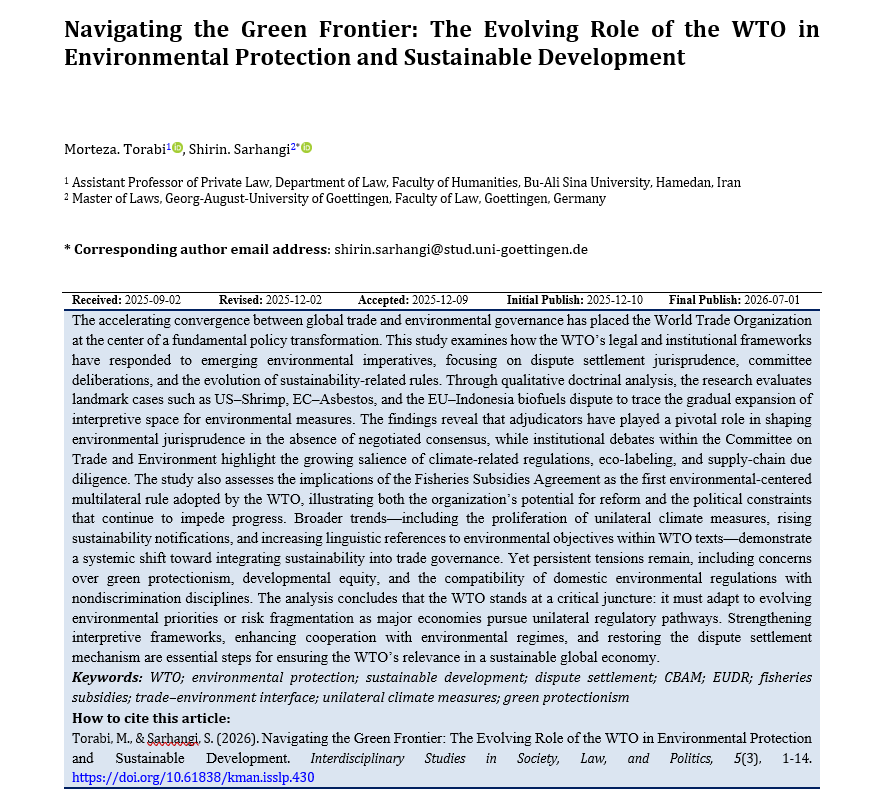
Navigating the Green Frontier: The Evolving Role of the WTO in Environmental Protection and Sustainable Development
Keywords:
Carbon Border Adjustment Mechanism (CBAM), Deforestation Regulation (EUDR), Environmental Disputes, Green Trade Barriers, Sustainable Development, Trade-Environment Nexus, WTO, Institutional AdaptationAbstract
The accelerating convergence between global trade and environmental governance has placed the World Trade Organization at the center of a fundamental policy transformation. This study examines how the WTO’s legal and institutional frameworks have responded to emerging environmental imperatives, focusing on dispute settlement jurisprudence, committee deliberations, and the evolution of sustainability-related rules. Through qualitative doctrinal analysis, the research evaluates landmark cases such as US–Shrimp, EC–Asbestos, and the EU–Indonesia biofuels dispute to trace the gradual expansion of interpretive space for environmental measures. The findings reveal that adjudicators have played a pivotal role in shaping environmental jurisprudence in the absence of negotiated consensus, while institutional debates within the Committee on Trade and Environment highlight the growing salience of climate-related regulations, eco-labeling, and supply-chain due diligence. The study also assesses the implications of the Fisheries Subsidies Agreement as the first environmental-centered multilateral rule adopted by the WTO, illustrating both the organization’s potential for reform and the political constraints that continue to impede progress. Broader trends—including the proliferation of unilateral climate measures, rising sustainability notifications, and increasing linguistic references to environmental objectives within WTO texts—demonstrate a systemic shift toward integrating sustainability into trade governance. Yet persistent tensions remain, including concerns over green protectionism, developmental equity, and the compatibility of domestic environmental regulations with nondiscrimination disciplines. The analysis concludes that the WTO stands at a critical juncture: it must adapt to evolving environmental priorities or risk fragmentation as major economies pursue unilateral regulatory pathways. Strengthening interpretive frameworks, enhancing cooperation with environmental regimes, and restoring the dispute settlement mechanism are essential steps for ensuring the WTO’s relevance in a sustainable global economy.
Downloads
References
Barral, V. (2012). Sustainable development in international law: Nature and operation of an evolutive legal norm. European Journal of International Law, 23(2), 377-400. https://doi.org/10.1093/ejil/chs016
Brack, D. (2024). Does the EU deforestation regulation comply with WTO requirements?
Capuzzi, B. (2024). Is the European Union deforestation regulation WTO-proof?
Chen, Z., & Kim, J. T. (2024). Study on the influence of international economic law of carbon emission trading on environmental sustainable development. Energies, 17(1), 1-14.
Chien, F., Hsu, C. C., Moslehpour, M., Sadiq, M., Tufail, B., & Ngo, T. Q. (2024). A step toward sustainable development: The nexus of environmental sustainability, technological advancement and green finance: Evidence from Indonesia. Environment, Development and Sustainability, 26, 11581-11602.
Cima, E., & Esty, D. C. (2024). Making international trade work for sustainable development: Toward a new WTO framework for subsidies. Journal of International Economic Law, 27(1), 1-17.
Cooreman, B. (2016). Addressing environmental concerns through trade: A case for extraterritoriality? International and Comparative Law Quarterly, 65(1), 1-21. https://doi.org/10.2139/ssrn.2598478
Cornago, E., & Berg, A. (2024). Learning from CBAM's transitional phase: Early impacts on trade and climate.
del Álamo, O. F. (2024). Green trade and trade greener: The WTO trade and environmental sustainability structured discussions. Global Trade and Customs Journal, 19, 81-92.
Directorate-General for, E. (2025). Commission implementing regulation laying down rules for the application of the deforestation regulation. European Commission.
Durel, L. (2024). Border carbon adjustment compliance and the WTO: The interactional evolution of law. Journal of International Economic Law, 27(1), 18-40. https://doi.org/10.1093/jiel/jgae007
Esty, D. C. (2001). Bridging the trade-environment divide. Journal of Economic Perspectives, 15(3), 113-130. https://doi.org/10.1257/jep.15.3.113
Fergusson, I. F. (2008). World trade organization negotiations: The Doha development agenda.
Gnintedem, P. J. L. (2024). Implementing the Doha Declaration in OAPI legislation: Do transition periods matter?
Hoekman, B. M., Mavroidis, P. C., & Saluste, M. (2021). Informing WTO reform: Dispute settlement performance, 1995-2020. Journal of World Trade, 55, 1-50.
Kalimo, H., Mateo, E., Happersberger, S., Jansson, M. S., & Majcher, K. (2024). Treading the environment trade nexus: Coherence of the EU trade agreements and the WTO law with the European Green Deal.
Lunenborg, P., & Naidu, V. (2024). How the EU's Carbon Border Adjustment Mechanism discriminates against foreign producers.
Lydgate, E. (2012). Sustainable development in the WTO: From mutual supportiveness to balancing. World Trade Review, 11, 621-639. https://doi.org/10.1017/S1474745612000341
Marceau, G., & Morosini, F. C. (2013). The status of sustainable development in the law of the World Trade Organization. In M. B. C. Junior & A. D. A. Júnior (Eds.), Arbitragem e comércio internacional: Estudos em homenagem a Luiz Olavo Baptista (pp. 59-91). Quartier Latin do Brasil.
Marceau, G. Z., & Wyatt, J. G. (2009). Trade and the environment: The WTO's efforts to balance economic and sustainable development. In P. H. T. T. Rita & C. Bovez (Eds.), Economie environnement ethique: De la responsabilité sociale et societal (pp. 225-235). Schulthess.
Marín Durán, G. (2023). Securing compatibility of carbon border adjustments with the multilateral climate and trade regimes. International and Comparative Law Quarterly, 72(1), 73-103. https://doi.org/10.1017/S0020589322000501
Mavroidis, P. C. (2022). The WTO dispute settlement system: How, why and where? Edward Elgar Publishing.
Mavroidis, P. C., & Neven, D. J. (2019). Greening the WTO environmental goods agreement, tariff concessions, and policy likeness. Journal of International Economic Law, 22, 373-388.
Palmer, A., & Werksman, J. (2001). World Trade Organization, European Communities-Measures affecting asbestos and asbestos-containing products (Panel Report). https://www.wto.org/english/tratop_e/dispu_e/cases_e/ds135_e.htm
Pavoni, R. (2010). Mutual supportiveness as a principle of interpretation and law-making: A watershed for the 'WTO-and-competing-regimes' debate? European Journal of International Law, 21, 649-679. https://doi.org/10.1093/ejil/chq046
Perkins, N. L. (1999). World Trade Organization: United States-Import prohibition of certain shrimp and shrimp products. International Legal Materials, 38, 118-175. https://doi.org/10.1017/S0020782900012912
Romanchyshyna, I. (2023). Technical barriers to trade in new generation RTAs and in the WTO agreements: Conflict or complementarity? Springer Cham. https://doi.org/10.1007/978-3-031-25791-9
Sabyrbekov, R., & Overland, I. (2024). Small and large friends of the EU's carbon border adjustment mechanism: Which non-EU countries are likely to support it? Energy Strategy Reviews, 51. https://doi.org/10.1016/j.esr.2024.101303
Sambhav, A. (2024). Legal analysis of carbon border adjustment mechanisms within the World's Trade Organization framework.
Sands, P. (2000). Environmental protection in the twenty-first century: Sustainable development and international law. In P. S. R. L. Revesz & R. B. Stewart (Eds.), Environmental law, the economy and sustainable development: The United States, the European Union and the international community (pp. 369-409). Cambridge University Press. https://doi.org/10.1017/CBO9780511720871.013
Sharma, U. (2024). The EU's carbon border adjustment mechanism (CBAM) and the erosion of multilateral trade principles: A legal analysis of WTO compatibility and developmental equity. Indian Journal of Law and Legal Research, 7(5).
Song, X., Du, S., Deng, C., Shen, P., Shen, P., Zhao, C., Chen, C., & Liu, X. (2025). Carbon emissions in China's steel industry from a life cycle perspective: Carbon footprint insights. Journal of Environmental Sciences, 148, 650-664.
Teehankee, M. (2020). Trade and environment governance at the World Trade Organization committee on trade and environment. Wolters Kluwer.
United, N. (2015). Transforming our world: The 2030 agenda for sustainable development.
United Nations Conference on, T., & Development. (2023). Trade and environment review 2023: Building a sustainable and resilient global economy.
Viñuales, J. E. (2024). Comparing environmental law systems. International and Comparative Law Quarterly, 73, 247-258.
World Trade, O. (2025). European Union-Certain measures concerning palm oil and oil palm crop-based biofuels (Panel Report DS593).
Young, M. A. (2023). The WTO fisheries subsidies agreement: Sovereignty, sustainability, and security. American Journal of International Law, 117, 677-685.
Downloads
Additional Files
Publication Timeline
- Submitted
- Revised
- Accepted
Issue
Section
License
Copyright (c) 2025 Morteza Torabi (Author); Shirin Sarhangi (Corresponding author)

This work is licensed under a Creative Commons Attribution-NonCommercial 4.0 International License.