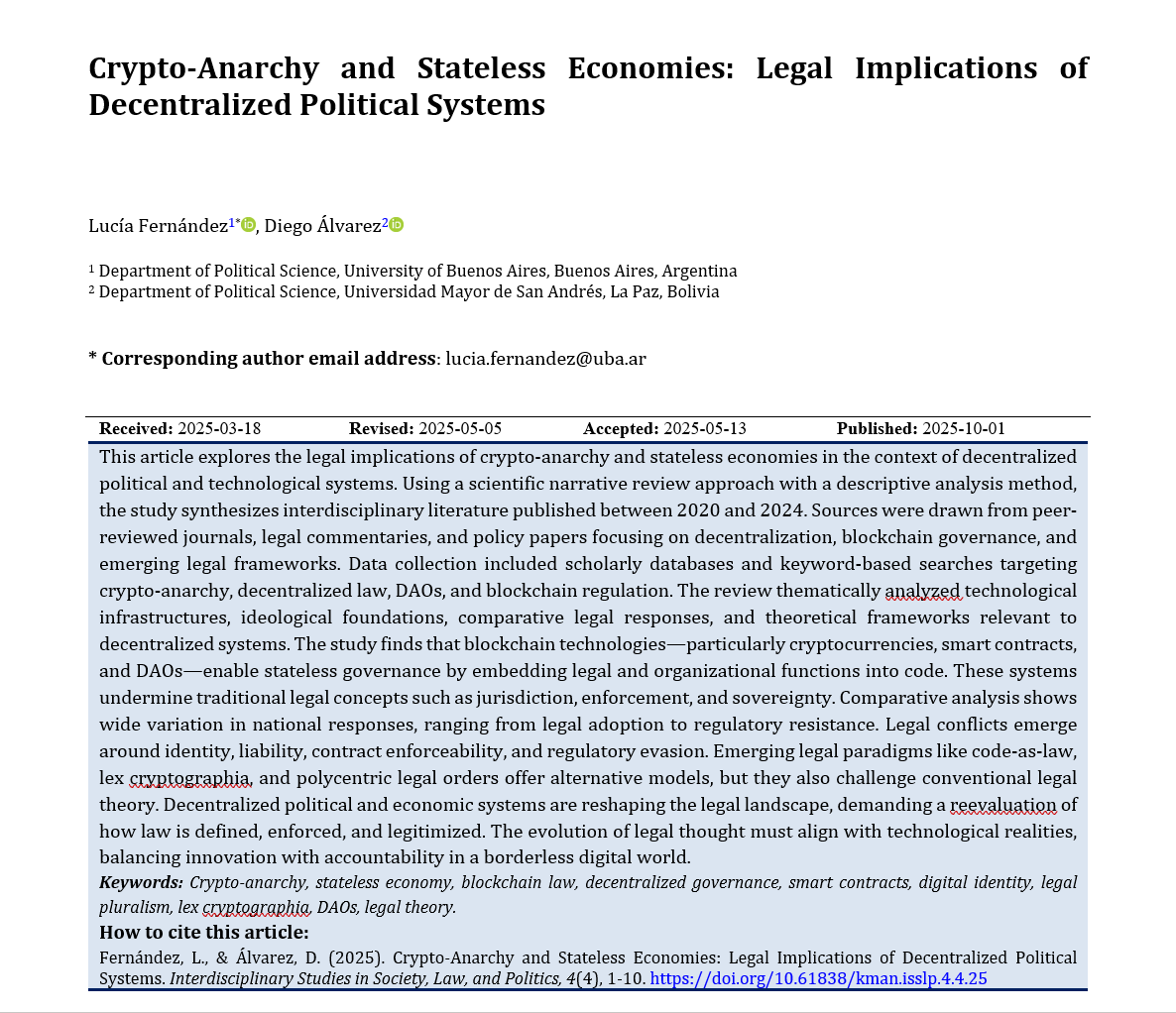
Crypto-Anarchy and Stateless Economies: Legal Implications of Decentralized Political Systems
DOI:
https://doi.org/10.61838/kman.isslp.4.4.25Keywords:
Crypto-anarchy, stateless economy, blockchain law, decentralized governance, smart contracts, digital identity, legal pluralism, lex cryptographia, DAOs, legal theoryAbstract
This article explores the legal implications of crypto-anarchy and stateless economies in the context of decentralized political and technological systems. Using a scientific narrative review approach with a descriptive analysis method, the study synthesizes interdisciplinary literature published between 2020 and 2024. Sources were drawn from peer-reviewed journals, legal commentaries, and policy papers focusing on decentralization, blockchain governance, and emerging legal frameworks. Data collection included scholarly databases and keyword-based searches targeting crypto-anarchy, decentralized law, DAOs, and blockchain regulation. The review thematically analyzed technological infrastructures, ideological foundations, comparative legal responses, and theoretical frameworks relevant to decentralized systems. The study finds that blockchain technologies—particularly cryptocurrencies, smart contracts, and DAOs—enable stateless governance by embedding legal and organizational functions into code. These systems undermine traditional legal concepts such as jurisdiction, enforcement, and sovereignty. Comparative analysis shows wide variation in national responses, ranging from legal adoption to regulatory resistance. Legal conflicts emerge around identity, liability, contract enforceability, and regulatory evasion. Emerging legal paradigms like code-as-law, lex cryptographia, and polycentric legal orders offer alternative models, but they also challenge conventional legal theory. Decentralized political and economic systems are reshaping the legal landscape, demanding a reevaluation of how law is defined, enforced, and legitimized. The evolution of legal thought must align with technological realities, balancing innovation with accountability in a borderless digital world.
Downloads
References
Alimuxamedov, S. (2023). The Institute of Decentralization of Public Administration: A Political and Legal Analysis. Review of Law Sciences, 7(1), 33-42. https://doi.org/10.51788/tsul.rols.2023.7.1./jayk4245
Chavali, D. (2024). Decentralized Intestacy Distribution: Exploring Autonomous Systems Leveraging Blockchain Technology. Interantional Journal of Scientific Research in Engineering and Management, 08(04), 1-5. https://doi.org/10.55041/ijsrem31543
Debela, K. W. (2021). Decentralized Urban Governance and Water Supply Service Delivery in Ethiopia: The Case of Adama City. American Journal of Management Science and Engineering, 6(3), 63. https://doi.org/10.11648/j.ajmse.20210603.12
Dudaeva, M. V. (2021). Historical and Political Analysis of the Decentralization Process in Italy. Russian Journal of Legal Studies (Moscow), 8(1), 65-74. https://doi.org/10.17816/rjls64467
Hartono, Y., & Kastowo, C. (2021). Perwujudan Politik Hukum Desentralisasi Asimetris Melalui Perda Dan Perdais Di Daerah Istimewa Yogyakarta. Kajian Hasil Penelitian Hukum, 5(2), 1. https://doi.org/10.37159/jmih.v5i2.1505
Lopez, J. F. O. (2022). Health Care System Decentralization, the Case of Venezuela Historic Evolution, Results, and Consequences of Its Institutional Reversal. Journal of Quality in Health Care & Economics, 5(S1), 1-12. https://doi.org/10.23880/jqhe-16000s1-001
Masduqie, M. H. A., & Santoso, T. B. (2023). Manfaat Dan Tantangan Regulasi Penyelenggaraan Financial Technology (Fintech) Di Indonesia. Jiesp, 2(2), 161-177. https://doi.org/10.54180/jiesp.2023.2.2.161-177
Mohite, M. S. B., Katkar, M. A., Patil, M. S., Powar, M. P., & Patil, P. (2024). Decentralised Legal Record Platform Using Blockchain Technology. International Journal for Research in Applied Science and Engineering Technology, 12(12), 2147-2151. https://doi.org/10.22214/ijraset.2024.66055
Nepomnyashchyy, O., Марушева, О., Medvedchuk, O. V., Lahunova, I. A., & Kislov, D. (2021). Processes of Decentralization of Territorial Organization of Government: Problems and Prospects. Journal of the National Academy of Legal Sciences of Ukraine, 28(2), 86-92. https://doi.org/10.37635/jnalsu.28(2).2021.86-92
Park, S., & Fowler, L. (2021). Political and Administrative Decentralization and Responses to COVID-19: Comparison of the United States and South Korea. International Journal of Organization Theory and Behavior, 24(4), 289-299. https://doi.org/10.1108/ijotb-02-2021-0022
Park, S. N. (2024). Imperial Presidential System : Today and in the Future. Institute for Legal Studies Chonnam National University, 44(4), 35-62. https://doi.org/10.38133/cnulawreview.2024.44.4.35
Pfister, M., Kannengießer, N., & Sunyaev, A. (2022). Finding the Right Balance: Technical and Political Decentralization in the Token Economy. 53-86. https://doi.org/10.1007/978-3-030-95108-5_3
Prum, V. (2020). Understanding Cambodia’s Weak Decentralization: From a Textual Approach. Jafess, 5(1), 30-35. https://doi.org/10.62458/jafess.160224.5(1)30-35
Rodionov, A. (2024). The Potential of Blockchain Technology for Creating Decentralized Identity Systems: Technical Capabilities and Legal Regulation. Irshad J. Law and Policy, 2(4), 19-30. https://doi.org/10.59022/ijlp.170
Sidorenko, E. L. (2023). Legal Status of Decentralized Finance: Towards the Articulation of Issue. Lex Russica, 76(3), 87-99. https://doi.org/10.17803/1729-5920.2023.196.3.087-099
Wiktorowska, A. (2021). Granice Decentralizacji. (85), 40-47. https://doi.org/10.31338/2544-3135.si.2020-85.3
Young, D. G. (2021). Young and Miller, Political Communication in Oxford Handbook of Poli Psych 3rd Ed. https://doi.org/10.31219/osf.io/mwdtu
Квітка, С., Borodin, Y., Yemelyanov, V., Moskalets, M., & Zubchenko, V. (2021). The Subsidiarity Principle and Legal and Economic Aspects of the Decentralization in Ukraine. Cuestiones Políticas, 39(68), 356-368. https://doi.org/10.46398/cuestpol.3968.22
Павлов, О., Pavlova, I., Павлова, Т. О., & молодший, О. П. (2020). Economic, Political, Legal and Managerial Consequences of the Decentralization of Public Power in Ukraine. Ukrainian Journal of Applied Economics, 5(4), 18-31. https://doi.org/10.36887/2415-8453-2020-4-2
Downloads
Additional Files
Publication Timeline
- Submitted
- Revised
- Accepted
Issue
Section
License

This work is licensed under a Creative Commons Attribution-NonCommercial 4.0 International License.