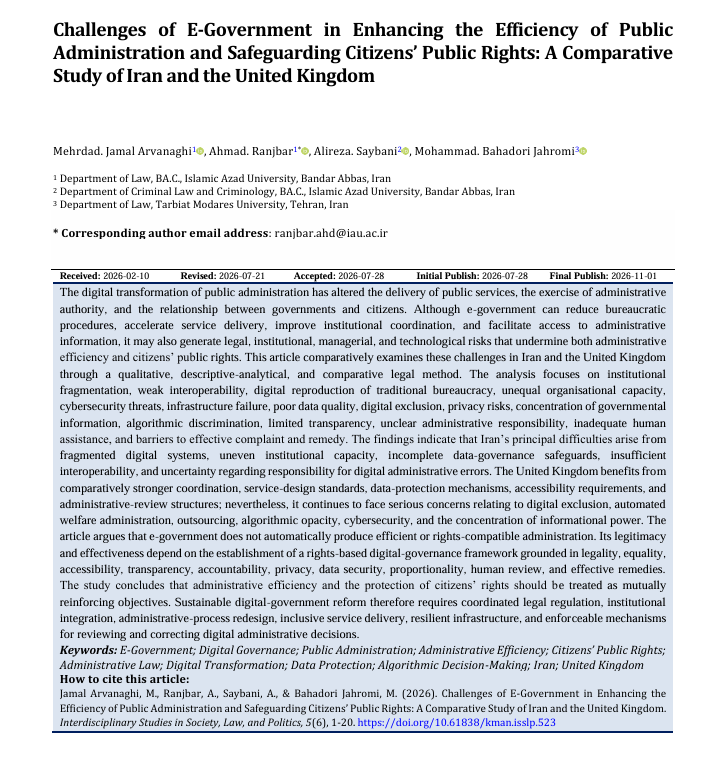
Challenges of E-Government in Enhancing the Efficiency of Public Administration and Safeguarding Citizens’ Public Rights: A Comparative Study of Iran and the United Kingdom
Keywords:
E-Government, Digital Governance, Public Administration, Administrative Efficiency, Citizens’ Public Rights, Administrative Law, Digital Transformation, Data Protection, Algorithmic Decision-Making, Iran, United KingdomAbstract
The digital transformation of public administration has altered the delivery of public services, the exercise of administrative authority, and the relationship between governments and citizens. Although e-government can reduce bureaucratic procedures, accelerate service delivery, improve institutional coordination, and facilitate access to administrative information, it may also generate legal, institutional, managerial, and technological risks that undermine both administrative efficiency and citizens’ public rights. This article comparatively examines these challenges in Iran and the United Kingdom through a qualitative, descriptive-analytical, and comparative legal method. The analysis focuses on institutional fragmentation, weak interoperability, digital reproduction of traditional bureaucracy, unequal organisational capacity, cybersecurity threats, infrastructure failure, poor data quality, digital exclusion, privacy risks, concentration of governmental information, algorithmic discrimination, limited transparency, unclear administrative responsibility, inadequate human assistance, and barriers to effective complaint and remedy. The findings indicate that Iran’s principal difficulties arise from fragmented digital systems, uneven institutional capacity, incomplete data-governance safeguards, insufficient interoperability, and uncertainty regarding responsibility for digital administrative errors. The United Kingdom benefits from comparatively stronger coordination, service-design standards, data-protection mechanisms, accessibility requirements, and administrative-review structures; nevertheless, it continues to face serious concerns relating to digital exclusion, automated welfare administration, outsourcing, algorithmic opacity, cybersecurity, and the concentration of informational power. The article argues that e-government does not automatically produce efficient or rights-compatible administration. Its legitimacy and effectiveness depend on the establishment of a rights-based digital-governance framework grounded in legality, equality, accessibility, transparency, accountability, privacy, data security, proportionality, human review, and effective remedies. The study concludes that administrative efficiency and the protection of citizens’ rights should be treated as mutually reinforcing objectives. Sustainable digital-government reform therefore requires coordinated legal regulation, institutional integration, administrative-process redesign, inclusive service delivery, resilient infrastructure, and enforceable mechanisms for reviewing and correcting digital administrative decisions.
Downloads
References
Abbasi, B. (2025). Administrative Law (9th ed.). Dadgostar.
Alvani, S. M. (2016). Public Management. Ney Publishing.
Bannister, F., & Connolly, R. (2014). ICT, Public Values and Transformative Government: A Framework and Programme for Research. Government Information Quarterly, 31(1), 119-128. https://doi.org/10.1016/j.giq.2013.06.002
Doan, U. T. T. (2025). Digital Transformation Influencing Civil Administrative Services at Grassroots Governance and Social Development. The Law and Development Review. https://doi.org/10.1515/ldr-2025-0009
Fertikh, K. (2025). The Missing Link. International Law, Administrative Power, and European Social Rights. Historical Social Research/Historische Sozialforschung, 50(1), 53-73.
Ghazi Shariat-Panahi, A. (2025). Administrative Law. Mizan.
Gorji Azandariani, A. A. (2016). Foundations of Public Law. Jangal Publishing.
Mergel, I., Edelmann, N., & Haug, N. (2019). Defining Digital Transformation: Results from Expert Interviews. Government Information Quarterly, 36(4), 101385. https://doi.org/10.1016/j.giq.2019.06.002
Ranchordas, S. (2023). Digital Welfare States and the Algorithmization of Rights. German Law Journal, 24(3), 471-490. https://doi.org/10.1017/glj.2023.29
Ranjbar, A. (2016). Administrative Justice: Conceptual Framework, Institutional Mechanisms, and Judicial Trends. Mizan Legal Foundation.
Shakeri, E. (2011). Electronic Government: Definitions and How It Works. Hafez(85), 70-73.
Tabatabaei Motameni, M. (2020). Administrative Law. Organization for Researching and Composing University Textbooks in the Humanities (SAMT).
Wirtz, B. W., Weyerer, J. C., & Geyer, C. (2019). Artificial Intelligence and the Public Sector: Applications and Challenges. International Journal of Public Administration, 42(7), 596-615. https://doi.org/10.1080/01900692.2018.1498103
Xu, J. (2024). Analysis of Law-Based Administrative Law Governance in the Context of the Sharing Economy. Applied Mathematics and Nonlinear Sciences, 9(1). https://doi.org/10.2478/amns-2024-0559
Downloads
Additional Files
Publication Timeline
- Submitted
- Revised
- Accepted
Issue
Section
License
Copyright (c) 2025 Mehrdad Jamal Arvanaghi (Author); Ahmad Ranjbar (Corresponding author); Alireza Saybani, Mohammad Bahadori Jahromi (Author)

This work is licensed under a Creative Commons Attribution-NonCommercial 4.0 International License.