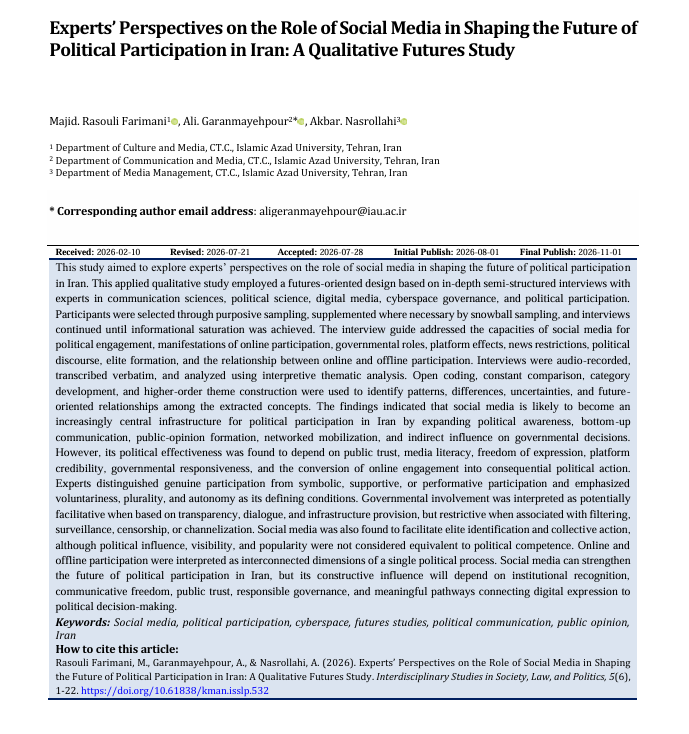
Experts’ Perspectives on the Role of Social Media in Shaping the Future of Political Participation in Iran: A Qualitative Futures Study
Keywords:
Social media, political participation, cyberspace, futures studies, political communication, public opinion, IranAbstract
This study aimed to explore experts’ perspectives on the role of social media in shaping the future of political participation in Iran. This applied qualitative study employed a futures-oriented design based on in-depth semi-structured interviews with experts in communication sciences, political science, digital media, cyberspace governance, and political participation. Participants were selected through purposive sampling, supplemented where necessary by snowball sampling, and interviews continued until informational saturation was achieved. The interview guide addressed the capacities of social media for political engagement, manifestations of online participation, governmental roles, platform effects, news restrictions, political discourse, elite formation, and the relationship between online and offline participation. Interviews were audio-recorded, transcribed verbatim, and analyzed using interpretive thematic analysis. Open coding, constant comparison, category development, and higher-order theme construction were used to identify patterns, differences, uncertainties, and future-oriented relationships among the extracted concepts. The findings indicated that social media is likely to become an increasingly central infrastructure for political participation in Iran by expanding political awareness, bottom-up communication, public-opinion formation, networked mobilization, and indirect influence on governmental decisions. However, its political effectiveness was found to depend on public trust, media literacy, freedom of expression, platform credibility, governmental responsiveness, and the conversion of online engagement into consequential political action. Experts distinguished genuine participation from symbolic, supportive, or performative participation and emphasized voluntariness, plurality, and autonomy as its defining conditions. Governmental involvement was interpreted as potentially facilitative when based on transparency, dialogue, and infrastructure provision, but restrictive when associated with filtering, surveillance, censorship, or channelization. Social media was also found to facilitate elite identification and collective action, although political influence, visibility, and popularity were not considered equivalent to political competence. Online and offline participation were interpreted as interconnected dimensions of a single political process. Social media can strengthen the future of political participation in Iran, but its constructive influence will depend on institutional recognition, communicative freedom, public trust, responsible governance, and meaningful pathways connecting digital expression to political decision-making.
Downloads
References
Ahmadi, Y. (2019). The effect of different types of social capital in social networks on different forms of political participation: Citizens aged 18 years and older in Sanandaj. Applied Sociology, 30(3), 1-22. https://doi.org/10.22108/jas.2019.110615.1366
Akhavan Kazemi, M., & Nikounahad, A. (2019). Futures studies of political development in Iran based on an analysis of inhibitors. Politics, 587-606.
Andreeva, M. (2019). Shaping political culture and participation through social networks. Journal of Liberty and International Affairs(2), 43-54.
Boulianne, S., & Theocharis, Y. (2020). Young people, digital media, and engagement: A meta-analysis of research. Social Science Computer Review, 38, 111-127. https://doi.org/10.1177/0894439318814190
Chen, J. V., Elakhdary, M. A., & Ha, Q. A. (2019). The continuance use of social network sites for political participation: Evidence from Arab countries. Journal of Global Information Technology Management, 22(3), 156-178.
Ebrahimi, S., Najafi, D., Mahmoudoghli, R., & Sadeghi Naghdali, Z. (2019). The relationship between social networks and political participation among students of the University of Isfahan. Rahbord(66), 0-263.
Gil de Zuniga, H., Diehl, T., Huber, B., & Liu, J. H. (2019). The citizen communication mediation model across countries: A multilevel mediation model of news use and discussion on political participation. Journal of Communication, 69, 144-167. https://doi.org/10.1093/joc/jqz002
Jost, J. T., Barbera, P., Bonneau, R., Langer, M., Metzger, M., Nagler, J., & Tucker, J. A. (2018). How social media facilitates political protest: Information, motivation, and social networks. Political Psychology, 39, 85-118.
Khaniki, H., & Khojir, Y. (2018). Social media and political participation: A meta-analysis of political participation among social media users. Interdisciplinary Studies in the Humanities(1), 101-127.
Majlesi, F. (2020). The influence of political models through social networks. Communication Management, 46.
Majlesi, M. (2020). The network society and politics. University of Tehran Press.
Matthes, J., Knoll, J., Valenzuela, S., Hopmann, D. N., & von Sikorski, C. (2019). A meta-analysis of the effects of cross-cutting exposure on political participation. Political Communication, 36, 523-542. https://doi.org/10.1080/10584609.2019.1619638
Rahbarghazi, M. R., Motamedi, S., & Shahriari, A. (2017). The effect of social networks on political participation considering the mediating variables of political discussion, political efficacy, and political culture. socio-cultural Development Studies(2), 127-149.
Rehan, T., Zolkepli, I. A., & Ahmad, M. (2022). Political participation of young voters: Tracing direct and indirect effects of social media and political orientations. Social Sciences, 11(2), 81. https://doi.org/10.3390/socsci11020081
Sadat Hosseini, M. (2018). Social networks and political participation. Electronic Journalism, 35.
Sadat Hosseini, S. M. (2018). Political participation and development in Iran. Islamic Sciences and Culture Academy.
Shams, M. (2020). Virtual social networks and political participation in elections. Neda-ye Ketab.
Toepfl, F. (2020). Comparing authoritarian publics: The benefits of a Boolean approach. Perspectives on Politics.
Tufekci, Z. (2017). Twitter and tear gas: The power and fragility of networked protest. Yale University Press.
Waeterloos, C., Walrave, M., & Ponnet, K. (2021). Designing and validating the Social Media Political Participation Scale: An instrument to measure political participation on social media. Technology in Society, 101493. https://doi.org/10.1016/j.techsoc.2020.101493
Weiss, J. (2020). What is youth political participation? Literature review on youth political participation and political attitudes. Frontiers in Political Science, 2, 1.
Downloads
Additional Files
Publication Timeline
- Submitted
- Revised
- Accepted
Issue
Section
License
Copyright (c) 2025 Majid Rasouli Farimani (Author); Ali Garanmayehpour (Corresponding author); Akbar Nasrollahi (Author)

This work is licensed under a Creative Commons Attribution-NonCommercial 4.0 International License.