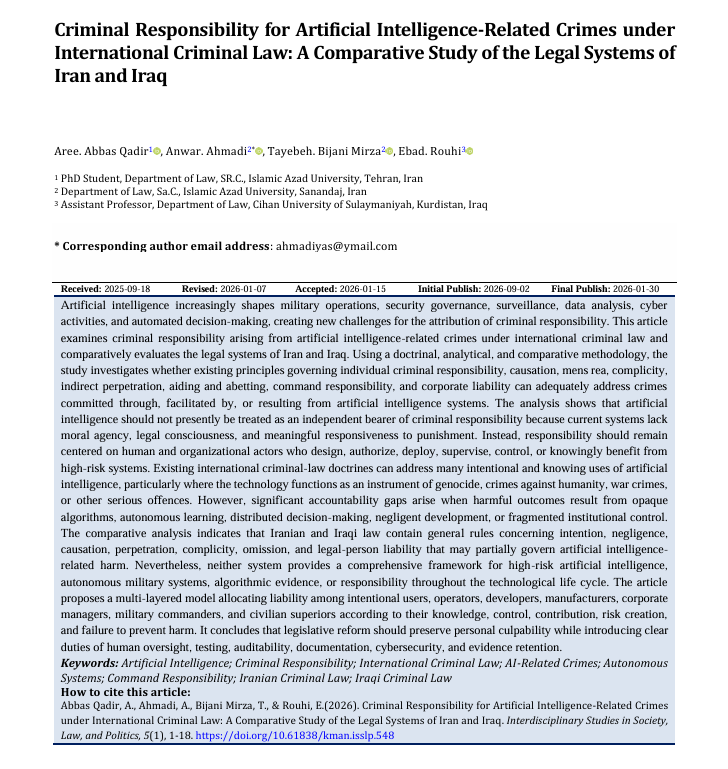
Criminal Responsibility for Artificial Intelligence-Related Crimes under International Criminal Law: A Comparative Study of the Legal Systems of Iran and Iraq
Keywords:
Artificial Intelligence, Criminal Responsibility, International Criminal Law, AI-Related Crimes, Autonomous Systems, Command Responsibility, Iranian Criminal Law, Iraqi Criminal LawAbstract
Artificial intelligence increasingly shapes military operations, security governance, surveillance, data analysis, cyber activities, and automated decision-making, creating new challenges for the attribution of criminal responsibility. This article examines criminal responsibility arising from artificial intelligence-related crimes under international criminal law and comparatively evaluates the legal systems of Iran and Iraq. Using a doctrinal, analytical, and comparative methodology, the study investigates whether existing principles governing individual criminal responsibility, causation, mens rea, complicity, indirect perpetration, aiding and abetting, command responsibility, and corporate liability can adequately address crimes committed through, facilitated by, or resulting from artificial intelligence systems. The analysis shows that artificial intelligence should not presently be treated as an independent bearer of criminal responsibility because current systems lack moral agency, legal consciousness, and meaningful responsiveness to punishment. Instead, responsibility should remain centered on human and organizational actors who design, authorize, deploy, supervise, control, or knowingly benefit from high-risk systems. Existing international criminal-law doctrines can address many intentional and knowing uses of artificial intelligence, particularly where the technology functions as an instrument of genocide, crimes against humanity, war crimes, or other serious offences. However, significant accountability gaps arise when harmful outcomes result from opaque algorithms, autonomous learning, distributed decision-making, negligent development, or fragmented institutional control. The comparative analysis indicates that Iranian and Iraqi law contain general rules concerning intention, negligence, causation, perpetration, complicity, omission, and legal-person liability that may partially govern artificial intelligence-related harm. Nevertheless, neither system provides a comprehensive framework for high-risk artificial intelligence, autonomous military systems, algorithmic evidence, or responsibility throughout the technological life cycle. The article proposes a multi-layered model allocating liability among intentional users, operators, developers, manufacturers, corporate managers, military commanders, and civilian superiors according to their knowledge, control, contribution, risk creation, and failure to prevent harm. It concludes that legislative reform should preserve personal culpability while introducing clear duties of human oversight, testing, auditability, documentation, cybersecurity, and evidence retention.
Downloads
References
Abbott, R., & Sarch, A. F. (2019). Punishing Artificial Intelligence: Legal Fiction or Science Fiction. UC Davis Law Review, 53(1), 323-384. https://lawreview.law.ucdavis.edu/archives/53/1/punishing-artificial-intelligence-legal-fiction-or-science-fiction
Ambos, K. (2021). Treatise on International Criminal Law, Volume I: Foundations and General Part (2nd ed.). Oxford University Press. https://doi.org/10.1093/law/9780192844262.001.0001
Asaro, P. M. (2012). On Banning Autonomous Weapon Systems: Human Rights, Automation, and the Dehumanization of Lethal Decision-Making. International Review of the Red Cross, 94(886), 687-709. https://doi.org/10.1017/S1816383112000768
Chengeta, T. (2016). Accountability Gap: Autonomous Weapon Systems and Modes of Responsibility in International Law. Denver Journal of International Law and Policy, 45(1), 1-50. https://digitalcommons.du.edu/djilp/vol45/iss1/3/
Crootof, R. (2015). The Killer Robots Are Here: Legal and Policy Implications. Cardozo Law Review, 36(5), 1837-1915. https://larc.cardozo.yu.edu/clr/vol36/iss5/6/
Cryer, R., Robinson, D., & Vasiliev, S. (2019). An Introduction to International Criminal Law and Procedure (4th ed.). Cambridge University Press. https://doi.org/10.1017/9781108680455
Hallevy, G. (2010). The Criminal Liability of Artificial Intelligence Entities: From Science Fiction to Legal Social Control. Akron Intellectual Property Journal, 4(2), 171-201. https://ideaexchange.uakron.edu/akronintellectualproperty/vol4/iss2/1/
Hallevy, G. (2013). When Robots Kill: Artificial Intelligence under Criminal Law. Northeastern University Press. https://books.google.com/books?id=9VvIMgEACAAJ
Matthias, A. (2004). The Responsibility Gap: Ascribing Responsibility for the Actions of Learning Automata. Ethics and Information Technology, 6(3), 175-183. https://doi.org/10.1007/s10676-004-3422-1
Sachoulidou, A. (2024). AI Systems and Criminal Liability: A Call for Action. Oslo Law Review, 11(1), 1-10. https://doi.org/10.18261/olr.11.1.3
Schabas, W. A. (2016). The International Criminal Court: A Commentary on the Rome Statute (2nd ed.). Oxford University Press. https://doi.org/10.1093/law/9780198739777.001.0001
Schmitt, M. N., & Thurnher, J. S. (2013). Out of the Loop: Autonomous Weapon Systems and the Law of Armed Conflict. Harvard National Security Journal, 4(2), 231-281. https://harvardnsj.org/2013/05/22/out-of-the-loop-autonomous-weapon-systems-and-the-law-of-armed-conflict/
Solum, L. B. (1992). Legal Personhood for Artificial Intelligences. North Carolina Law Review, 70(4), 1231-1287. https://scholarship.law.unc.edu/nclr/vol70/iss4/4/
Sparrow, R. (2007). Killer Robots. Journal of Applied Philosophy, 24(1), 62-77. https://doi.org/10.1111/j.1468-5930.2007.00346.x
Werle, G., & Jeßberger, F. (2020). Principles of International Criminal Law (4th ed.). Oxford University Press. https://global.oup.com/academic/product/principles-of-international-criminal-law-9780198826859
Downloads
Additional Files
Publication Timeline
- Submitted
- Revised
- Accepted
Issue
Section
License
Copyright (c) 2026 Aree Abbas Qadir (Author); Anwar Ahmadi (Corresponding author); Tayebeh Bijani Mirza, Ebad Rouhi (Author)

This work is licensed under a Creative Commons Attribution-NonCommercial 4.0 International License.