Modernization of Laws Governing Family Law
Keywords:
dynamic ijtihad, gender equality, specialized family court, secondary jurisprudential rules, family mediationAbstract
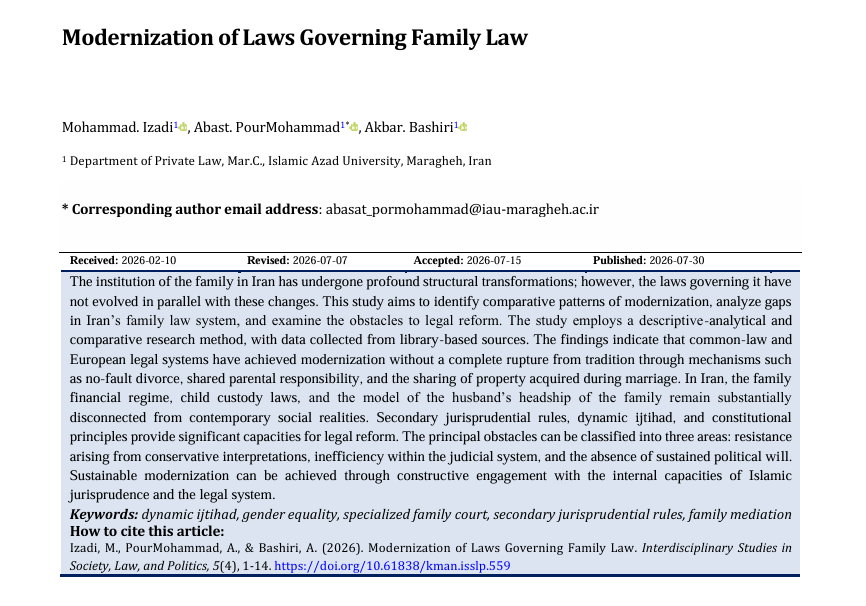
The institution of the family in Iran has undergone profound structural transformations; however, the laws governing it have not evolved in parallel with these changes. This study aims to identify comparative patterns of modernization, analyze gaps in Iran’s family law system, and examine the obstacles to legal reform. The study employs a descriptive-analytical and comparative research method, with data collected from library-based sources. The findings indicate that common-law and European legal systems have achieved modernization without a complete rupture from tradition through mechanisms such as no-fault divorce, shared parental responsibility, and the sharing of property acquired during marriage. In Iran, the family financial regime, child custody laws, and the model of the husband’s headship of the family remain substantially disconnected from contemporary social realities. Secondary jurisprudential rules, dynamic ijtihad, and constitutional principles provide significant capacities for legal reform. The principal obstacles can be classified into three areas: resistance arising from conservative interpretations, inefficiency within the judicial system, and the absence of sustained political will. Sustainable modernization can be achieved through constructive engagement with the internal capacities of Islamic jurisprudence and the legal system.
Downloads
References
Aghapour, K. (2025). Analysis of the Iranian Legal Approach to Protecting the Wife's Mental and Psychological Health within the Family Environment. Comparative Research in Jurisprudence, Law and Politics, 1(1), 328-342.
Amini Kouchaksaraei, M., & Naseri, A. (2025). Challenges to Women's Moral Rights in the Adjudication Process of Family Disputes. Studies in Jurisprudence and Cultural Law, 1(1), 115-140.
Ansori, A., & Juliansyahzen, M. I. (2022). The Contestation of the Family Law Discourse in the Digital Age: Islam, State, and Gender. Samarah: Jurnal Hukum Keluarga dan Hukum Islam, 6(1), 244-272.
Azimzadeh Ardebili, F., Mashayekhi, F., & Izadi, N. (2023). Standard and Emerging Families in the Legal Systems of Iran and the United States. Scientific Biannual Journal of Family Jurisprudence and Law, 28(78), 105-137.
Begum, M. S. I., Ismail, I., Yaakob, Z. A., Razick, A. S., & Abdullah, M. M. A. (2024). Gender Equity in Muslim Family Law: Modern and Contemporary 'Ulamā's View. Al-Ahkam, 34(2), 221-256.
Cahn, N., Huntington, C., & Scott, E. (2022). Family Law for the One-Hundred-Year Life. Yale Law Journal, 132, 1691.
Hedayatnia, F. (2024). Minimalism in Family Criminal Law. Islamic Law, 21(80), 119-147.
Hedayatnia, F., & Bateni, E. (2024). An Analysis of Iran's Legislative Policy in Family Criminal Law. Islamic Studies of Women and Family, 11(20), 25-50.
Huntington, C. (2022). Pragmatic Family Law. Harvard Law Review, 136, 1501.
Husain, S., Ayoub, N. P., & Hassmann, M. (2024). Legal Pluralism in Contemporary Societies: Dynamics of Interaction between Islamic Law and Secular Civil Law. SYARIAT: Akhwal Syaksiyah, Jinayah, Siyasah and Muamalah, 1(1) 1-14.
Javar, H., Osouli Yamchi, M., & Ashayeri Monfared, M. (2025). Normative Custom and Its Effect on Restricting Will with Emphasis on Family Law. Scientific Biannual Journal of Family Jurisprudence and Law, 30(82), 5-35.
Kohansal Kalkenari, M., Bahraini, M. J., & Asgari, A. (2025). Pathology of the Wife's Financial Rights under the Family Protection Act of 2012. Comparative Research in Jurisprudence, Law and Politics, 1(1), 144-159.
Mohaghegh Damad, S. M., Shahmoradi Zavareh, M., Yavari, A., & Seifi, G. (2024). The Concept and Application of Regulation in the Family Institution: A Comparative Study of Iranian and French Law. Legal Research Quarterly, 27(2), 1-18.
Nasari Yousefi, F., Roshanaei, O., & Roshanaei, H. (2025). Family Law and Legal Challenges Facing Women in Iran. Journal of Elites in Science and Engineering, 10(3), 225-230.
Sadeghi, K., & Tavallaei, A. (2024). Assessing the Feasibility of Joint Custody in the Iranian Legal System with Reference to the Laws of the United States, England, and Malaysia. Jurisprudential and Legal Studies of Women and Family(13), 145-172.
Satpathy, S. (2024). The Evolving Landscape of Family Law: Addressing Contemporary Issues. International Journal of Law Management & Humanities, 7(1), 1092.
Winkler, S. (2025). Some Reflections upon the Way the Digital World Is Impacting Family Law. In Exploring Digital Legal Landscapes (pp. 135-151). Logos Verlag.
Xiao, W. (2024). Expansion and Restriction: Divergent Paths Towards Modernizing Family Laws in Japan and China, 1868-1930. The American Journal of Comparative Law, 72(2), 428-473.
Zeineddini, F., & Gharachemani, F. (2024). Examining Women's Financial and Economic Rights in Light of Social Transformations: A New Approach to Property Independence and Community Regimes in the Iranian Family Context. Strategic studies of women(103), 75-101.
Zolfaghari Darzi, A., & Habibi Tabar, J. (2025). Government Intervention in Criminalization within Family Law and Its Foundations. Jurisprudential-Legal Studies of Women and Family, 22-32.
Downloads
Additional Files
Publication Timeline
- Submitted
- Revised
- Accepted
Issue
Section
License
Copyright (c) 2026 Mohammad Izadi (Author); Abast PourMohammad (Corresponding author); Akbar Bashiri (Author)

This work is licensed under a Creative Commons Attribution-NonCommercial 4.0 International License.