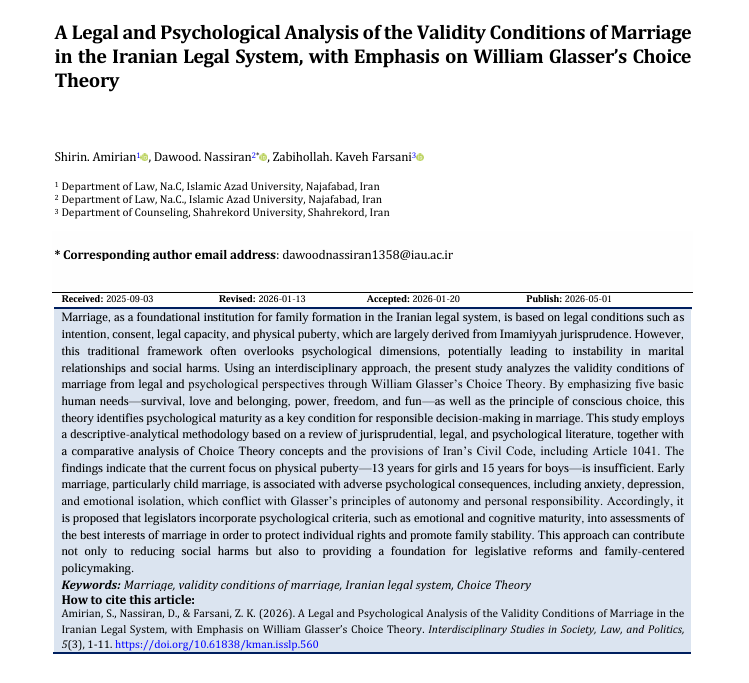
A Legal and Psychological Analysis of the Validity Conditions of Marriage in the Iranian Legal System, with Emphasis on William Glasser’s Choice Theory
Keywords:
Marriage, validity conditions of marriage, Iranian legal system, Choice TheoryAbstract
Marriage, as a foundational institution for family formation in the Iranian legal system, is based on legal conditions such as intention, consent, legal capacity, and physical puberty, which are largely derived from Imamiyyah jurisprudence. However, this traditional framework often overlooks psychological dimensions, potentially leading to instability in marital relationships and social harms. Using an interdisciplinary approach, the present study analyzes the validity conditions of marriage from legal and psychological perspectives through William Glasser’s Choice Theory. By emphasizing five basic human needs—survival, love and belonging, power, freedom, and fun—as well as the principle of conscious choice, this theory identifies psychological maturity as a key condition for responsible decision-making in marriage. This study employs a descriptive-analytical methodology based on a review of jurisprudential, legal, and psychological literature, together with a comparative analysis of Choice Theory concepts and the provisions of Iran’s Civil Code, including Article 1041. The findings indicate that the current focus on physical puberty—13 years for girls and 15 years for boys—is insufficient. Early marriage, particularly child marriage, is associated with adverse psychological consequences, including anxiety, depression, and emotional isolation, which conflict with Glasser’s principles of autonomy and personal responsibility. Accordingly, it is proposed that legislators incorporate psychological criteria, such as emotional and cognitive maturity, into assessments of the best interests of marriage in order to protect individual rights and promote family stability. This approach can contribute not only to reducing social harms but also to providing a foundation for legislative reforms and family-centered policymaking.
Downloads
References
Ainiyah, S. N., & Rosiana, D. (2025). The relationship between emotional maturity and marital loneliness among Generation Z. Bandung Conference Series: Psychology Science,
Akbari Mahmoud, M., Zarei Mahmoudabadi, M., & Ami, A. (2024). A jurisprudential reflection on child marriage in light of the child's welfare and mental health in the contemporary era. Medical Law Research Journal, 18(59), 381-399.
Ameri, E., & Vaziri Nasab, A. (2023). Effectiveness of Glasser's choice theory training on marital burnout and family instability among couples with a military spouse. Journal of the Faculty of Medicine, Mashhad University of Medical Sciences, 64(5), 4108-4118.
Daud, F. K., & Rosadi, A. (2021). Dynamics of Islamic family law and gender issues in Iran: Between the thought of secular elites and Islamic scholars. Volksgeist: Jurnal Ilmu Hukum dan Konstitusi, 4(2), 205-220. https://doi.org/10.24090/volksgeist.v4i2.5258
Deylam Salehi, H., Asghari Ebrahimabad, M. J., & Aghamohammadian Sharbaf, H. (2024). Predicting emotional maturity from early maladaptive schemas in university students: Emphasizing the mediating role of perceived social support. Sabzevar University of Medical Sciences Journal, 31(6), 853-864.
Esmaeili, F., Safiri, A., & Chitsazian, M. (2024). Documentary foundations of the theory of the invalidity of child marriage according to Ayatollah Makarem Shirazi's fatwa. Family Research, 20(3), 51-71.
Farahmand, M., Danafar, F., & Pour Ebrahimabadi, M. (2020). Exploring marital experiences of child marriage: Emotional-cognitive enmeshment and powerlessness. Contemporary Sociological Research, 9(17), 115-145.
Ghiasi Sani, A., & Mousavi Bojnourdi, A. S. M. (2008). The age of marriage for girls in the foundations of Islamic law. Family Jurisprudence and Law, 13(48), 91-105.
Gholami Gharah Shiran, Z., Sanaei Zaker, B., Kiamanesh, A., & Zahrakar, K. (2022). The role of attitudes toward marriage and emotional maturity in predicting marital instability among women and men. Journal of Psychological Science, 21(116), 1581-1598.
Ghorbanpour Lofmajani, A. (2023). The cognitive transformation of the concept of human beings and its application to Piaget's cognitive development theory among male primary-school students. Health and Education in Childhood Quarterly, 4(3), 17-36.
Haji Adineh, S., & Kalhor Nia Golkar, M. (2019). The relationship of emotional and spiritual intelligence with students' attitudes toward extramarital relationships. Social Health, 6(4), 380-388.
Jafari Harandi, R., & Rajaei Mousavi, S. F. (2019). Predicting emotional maturity based on family emotional climate and parents' religiosity among female students. Educational Psychology Studies, 16(34), 1-26.
Javadiaan, S. R., Shomali Ahmadabadi, E., Torkashvand Moradabadi, M., & Abedi, M. (2019). Contexts and consequences of early marriage among girls aged 13 to 16 years in Ardakan, Yazd. Iranian Journal of Social Studies, 13(4), 31-54.
Kadhim, N. J. (2025). Identity formation in adolescence: An Eriksonian approach to Arthur Golden's Memoirs of a Geisha. Theory and Practice in Language Studies, 15(10), 3208-3215. https://doi.org/10.17507/tpls.1510.07
Khatibi, S., Goodarzi, M., & YarAhmadi, Y. (2019). The relationship between responsibility and Glasser's basic needs with satisfying marriage: The mediating role of resilience. Journal of the Faculty of Medicine, Mashhad University of Medical Sciences, 62(Special Issue (Psychology)), 16-33.
Maisarah, Afrizal, Zulfahmi, Mauliza, F., & Murni, F. (2019). Minimum marriage age: Study of fiqh of four madhabs. Britain International of Humanities and Social Sciences Journal, 1(2), 149-158. https://doi.org/10.33258/biohs.v1i2.46
Majdi, A. A., Kermani, M., Baradaran Kashani, Z., & Khedmati Beghamch, F. (2023). Women's lived experiences of early marriage: A qualitative study. Family Research, 19(2), 197-215.
Mohseni, N. S., & Ebrahimi, E. (2023). An analysis of Quranic commentators' views on the implication of Verse 4 of Surah Al-Talaq for child marriage. Islamic Women's and Family Research Journal, 11(1), 95-117.
Mousavi, Z., Shariati, E., & Mozaffari Sibenni, K. (2020). A jurisprudential and legal examination of the age of marriage in Iranian law. Women and Family Studies, 8(3), 9-28.
Omrani Pour, A., & Mohammadmoradi, A. (2011). An analysis of environmental characteristics in Erikson's theory of personality. Armanshahr Architecture and Urban Development, 4(7), 41-50.
Parsapour, M. B. (2011). A jurisprudential reflection on the validity of maturity in marriage contracts. Islamic Law, 8(29), 89-109.
Pourabbasi, S., Kordzangeneh, J., & Sharifi, M. (2022). Contexts and determinants of women's early marriage in Ahvaz County. Iranian Population Studies Association Letter, 17(34), 179-206.
Safavi, H. S., & Minaei, M. (2015). Lived experiences of adolescent girls as wives: A study of early marriage among girls in Aran and Bidgol. Women's Research Journal, 6(Special Issue), 87-106.
Sahebi, A., Zalizadeh, M., & Zalizadeh, M. (2015). Choice theory: An approach toward responsibility. Ruyesh-e Ravanshenasi, 4(2), 113-134.
Sajjadi, S. M. (2017). Puberty and child marriage from the perspective of Islamic jurisprudence. Answer, 2(7), 33-62.
Valadkhani, M., Mahmoudpour, A., Farahbakhsh, K., & Salimi Bejestani, H. (2016). The effect of age at marriage, spouse-selection patterns, and spousal age differences on married women's quality of life in Tehran. Clinical Psychology Studies, 7(25), 173-190.
Wulansari, P., Ernawati, S., & Putri, D. R. (2025). Psychological maturity among prospective civil-servant brides and grooms in Surakarta, Central Java. Khatulistiwa: Jurnal Pendidikan dan Sosial Humaniora, 5(4), 465-483. https://doi.org/10.55606/khatulistiwa.v5i4.7729
Zarei Mahmoudabadi, H., & Zarei, F. (2021). Causes and consequences of early marriage and child marriage among female students in Yazd Province (student divorce): A grounded theory study. Toloo-e Behdasht, 20(3), 12-27.
Downloads
Additional Files
Publication Timeline
- Submitted
- Revised
- Accepted
Issue
Section
License
Copyright (c) 2026 Shirin Amirian (Author); Dawood Nassiran (Corresponding author); Zabihollah Kaveh Farsani (Author)

This work is licensed under a Creative Commons Attribution-NonCommercial 4.0 International License.