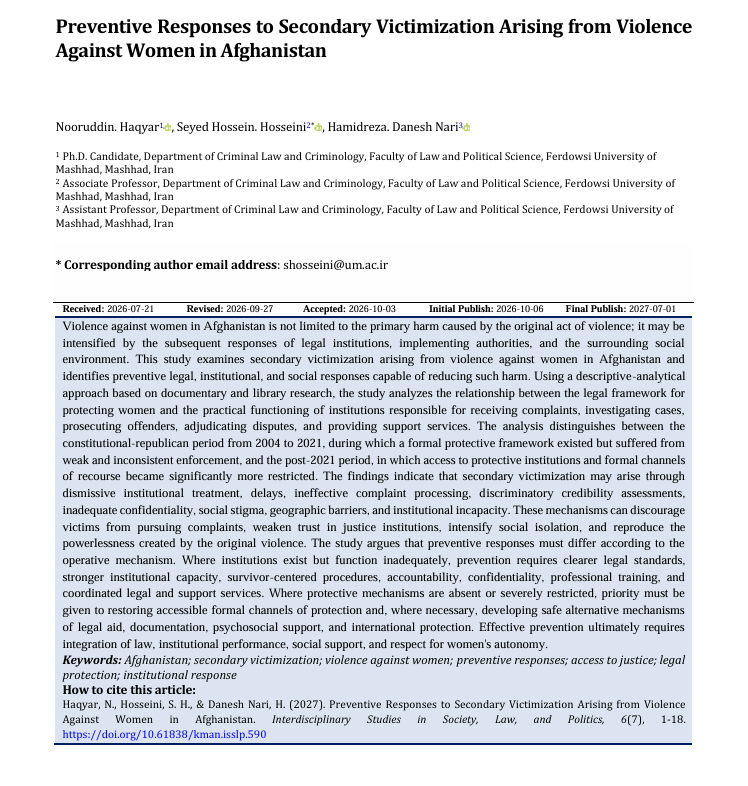
Preventive Responses to Secondary Victimization Arising from Violence Against Women in Afghanistan
Keywords:
Afghanistan, secondary victimization, women's rights, violence against women, legislative and executive structureAbstract
Violence against women in Afghanistan is not limited to the primary harm caused by the original act of violence; it may be intensified by the subsequent responses of legal institutions, implementing authorities, and the surrounding social environment. This study examines secondary victimization arising from violence against women in Afghanistan and identifies preventive legal, institutional, and social responses capable of reducing such harm. Using a descriptive-analytical approach based on documentary and library research, the study analyzes the relationship between the legal framework for protecting women and the practical functioning of institutions responsible for receiving complaints, investigating cases, prosecuting offenders, adjudicating disputes, and providing support services. The analysis distinguishes between the constitutional-republican period from 2004 to 2021, during which a formal protective framework existed but suffered from weak and inconsistent enforcement, and the post-2021 period, in which access to protective institutions and formal channels of recourse became significantly more restricted. The findings indicate that secondary victimization may arise through dismissive institutional treatment, delays, ineffective complaint processing, discriminatory credibility assessments, inadequate confidentiality, social stigma, geographic barriers, and institutional incapacity. These mechanisms can discourage victims from pursuing complaints, weaken trust in justice institutions, intensify social isolation, and reproduce the powerlessness created by the original violence. The study argues that preventive responses must differ according to the operative mechanism. Where institutions exist but function inadequately, prevention requires clearer legal standards, stronger institutional capacity, survivor-centered procedures, accountability, confidentiality, professional training, and coordinated legal and support services. Where protective mechanisms are absent or severely restricted, priority must be given to restoring accessible formal channels of protection and, where necessary, developing safe alternative mechanisms of legal aid, documentation, psychosocial support, and international protection. Effective prevention ultimately requires integration of law, institutional performance, social support, and respect for women's autonomy.
Downloads
References
Alemi, Q., Stempel, C., Montgomery, S., Koga, P. M., Smith, V., Baek, K., & Malika, N. (2022). Prevalence and social-ecological correlates of intimate partner violence in a conflict zone—evidence from the 2015 Afghanistan Demographic and Health Survey. Violence Against Women, 28(11), 2825-2856.
Ashraf, A., & Kennedy-Pipe, C. (2022). Woman, war, and the politics of emancipation in Afghanistan. LSE Public Policy Review, 2(3).
Bagherinezhad, Z. (2024). Violation of women's rights in internal armed conflicts. Journal of Criminal Law Research, 12(46), 115-144.
Basu, K. (2023). Gender-based violence in Afghanistan: A distraught state in denial. International Journal of Human Rights and Constitutional Studies, 10(3), 285-302.
Campbell, R. (2008). The psychological impact of rape victims' experiences with the legal, medical, and mental health systems. American psychologist, 63(8), 702-717.
Campbell, R., Sefl, T., Barnes, H. E., Ahrens, C. E., Wasco, S. M., & Zaragoza-Diesfeld, Y. (1999). Community services for rape survivors: Enhancing psychological well-being or increasing trauma? Journal of consulting and clinical psychology, 67(6), 847-858.
Chauhan, B. G., & Jungari, S. (2022). Prevalence and predictors of spousal violence against women in Afghanistan: Evidence from Demographic and Health Survey data. Journal of Biosocial Science, 54(2), 225-242.
Dutta, M. (2023). Disappearing Afghan women from public spaces—Collapse of women's rights in Afghanistan. Bulletin of the Karaganda University: History, Philosophy Series, 111(3), 79-89.
Fricker, M. (2007). Epistemic injustice: Power and the ethics of knowing. Oxford University Press.
Hänel, H. C. (2025). Willful testimonial injustice as a form of epistemic injustice. European Journal of Philosophy, 33(1), 183-201.
Hashimi, G. (2017). Defending the principle of legality in Afghanistan: Toward a unified interpretation of Article 130 to the Afghan Constitution. Oregon Review of International Law, 18(2), 185-226.
Innayah, T. K. P., & Yulianti, D. (2025). Cultural violence against women under Taliban rule in Afghanistan (2021–2022). ICMES Journal, 9(2), 135-164.
Kaul, A., Saboor, L., Ahmad, A., Mannell, J., Paphitis, S. A., & Devakumar, D. (2024). What are the experiences and psychosocial needs of female survivors of domestic violence in Afghanistan? A qualitative interview study in three Afghan provinces. BMJ open, 14(6), e079615.
Mahendru, R. (2021). Girls and women speak out from Afghan moral prisons: Tackling extremism and violence against women in a conflict environment. Global Public Health, 16(5), 729-745.
Mannell, J., Grewal, G., Ahmad, L., & Ahmad, A. (2021). A qualitative study of women's lived experiences of conflict and domestic violence in Afghanistan. Violence Against Women, 27(11), 1862-1878.
Mukerji, R., Saboor, L., Paphitis, S., Devakumar, D., & Mannell, J. (2023). How does domestic violence stigma manifest in women's lives in Afghanistan? A study of survivors' lived experiences of help-seeking across three provinces. Global Public Health, 18(1), 2212035.
Niland, N. (2025). Gendered violence in Afghanistan: It can be consigned to history. In Human Rights and Gender Based Violence in Asia (pp. 227-244). Routledge.
Rahman, M., Saha, P., Anwar, N., & Hossain, A. (2021). He hurts her womb: Physical-sexual violence and pregnancy complications among women in Afghanistan. Health Promotion Perspectives, 11(4), 485.
Saboor, L., Ahmad, L., & Ahmad, A. (2022). The bleak future of Afghan women's health under the Taliban. The lancet, 399(10328), 893-894.
Sopacua, M. G. (2023). Perception of Indonesia and Afghanistan in preventing psychic violence against the household women. Jambura Law Review, 5(2), 251-277.
Taheri, M., Fitzpatrick, S., & McCormack, L. (2025). From the brink of survival to "become the person that they want to become": Gender minimization, refugee trauma, and growth in women from Afghanistan. Traumatology, 31(2), 306.
Tan, N. F., & Ineli-Ciger, M. (2023). Group-based protection of Afghan women and girls under the 1951 refugee convention. International & Comparative Law Quarterly, 72(3), 793-817.
Tariq, M., Khan, A., Arif, I., Irshad, U., Ali, A., Saeed, S., & Ali, A. (2021). The theory of victimization: A case study of women in Afghanistan. International Journal of Innovation, Creativity and Change, 15(8), 339-350.
Umarach, M. S., Silitonga, D. F., & Muljabar, H. (2022). Analysis of the significant increase of gender-based violence during the Covid-19 pandemic in the conflict zone: The case of Afghanistan. Journal of Islamic World and Politics, 6(1), 1-19.
Zada, S. Q. (2020). Legislative, institutional and policy reforms to combat violence against women in Afghanistan. Indian Journal of International Law, 59(1-4), 257-283.
Downloads
Additional Files
Publication Timeline
- Submitted
- Revised
- Accepted
Issue
Section
License
Copyright (c) 2025 Nooruddin Haqyar (Author); Seyed Hossein Hosseini (Corresponding author); Hamidreza Danesh Nari (Author)

This work is licensed under a Creative Commons Attribution-NonCommercial 4.0 International License.