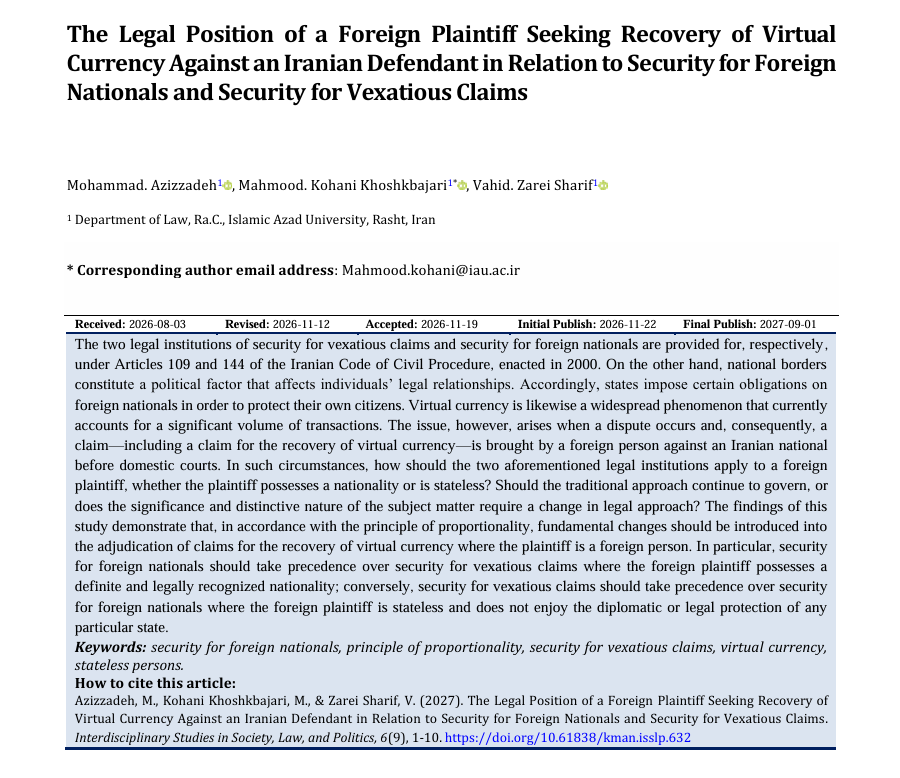
The Legal Position of a Foreign Plaintiff Seeking Recovery of Virtual Currency Against an Iranian Defendant in Relation to Security for Foreign Nationals and Security for Vexatious Claims
Keywords:
security for foreign nationals, principle of proportionality, security for vexatious claims, virtual currency, stateless personsAbstract
The two legal institutions of security for vexatious claims and security for foreign nationals are provided for, respectively, under Articles 109 and 144 of the Iranian Code of Civil Procedure, enacted in 2000. On the other hand, national borders constitute a political factor that affects individuals’ legal relationships. Accordingly, states impose certain obligations on foreign nationals in order to protect their own citizens. Virtual currency is likewise a widespread phenomenon that currently accounts for a significant volume of transactions. The issue, however, arises when a dispute occurs and, consequently, a claim—including a claim for the recovery of virtual currency—is brought by a foreign person against an Iranian national before domestic courts. In such circumstances, how should the two aforementioned legal institutions apply to a foreign plaintiff, whether the plaintiff possesses a nationality or is stateless? Should the traditional approach continue to govern, or does the significance and distinctive nature of the subject matter require a change in legal approach? The findings of this study demonstrate that, in accordance with the principle of proportionality, fundamental changes should be introduced into the adjudication of claims for the recovery of virtual currency where the plaintiff is a foreign person. In particular, security for foreign nationals should take precedence over security for vexatious claims where the foreign plaintiff possesses a definite and legally recognized nationality; conversely, security for vexatious claims should take precedence over security for foreign nationals where the foreign plaintiff is stateless and does not enjoy the diplomatic or legal protection of any particular state.
Downloads
References
Almasi, N. A. (2008). Conflict of Laws. University Publishing Center.
Beheshti, M. J., & Mardani, N. (2006). Civil Procedure (Vol. 2). Mizan.
Brownlie, I. (2003). Principles of Public International Law. Oxford University Press.
Chalmers, D., & Tomkins, A. (2007). European Union Public Law. Cambridge University Press.
Eftekhari Jahromi, G., & Alsan, M. (2020). Civil Procedure (Vol. 3). Majd.
Forghan Doust Haghighi, K., & Naddaf, R. (2018). A Review of Cryptocurrencies: Opportunities and Threats. New Research Approaches in Management and Accounting, 3(9), 61-74.
Ghaffari, J. (2005). Civil Procedure. Payame Noor University Press.
Ghamami, M., & Mohseni, H. (2007). Principles of Transnational Civil Procedure. Mizan.
Gholizadeh, A. (2003). Civil Procedure (Vol. 3). University of Isfahan.
Hashemi, S. M. (2003). Human Rights Protections and Guarantees in Domestic Law and the International System. Journal of Legal Research(38).
Imanian, F., Shams, A., & Tafreshi, M. I. (2003). Interpretation of Civil Rights in the Civil Code. Modares Humanities: Comparative Law Research, 7(28), 1-32.
Karimi, A. (2010). Civil Procedure. Majd.
Kavanagh, A. (2009). Constitutional Review under the UK Human Rights Act. Under Press.
Khaleghian, J. (2006). Security for Potential Damages. Mohajer.
Malekzadeh, F. (2011). Explanatory Amendments to Criminal and Civil Procedure. Majd.
Matin Daftari, A. (2009). Civil and Commercial Procedure (Vol. 2). Majd.
Nezam al-Molki, J., & Jahanshahloo, M. (2021). Simultaneous Security for Vexatious Litigation and Security for Foreign Nationals in Iranian Law: A Look at Judicial Practice. Legal Studies, 13(1), 259-285.
Nobakht, Y. (2014). A Look at Civil Procedure (Civil Law). Rahnama (Andisheha) Cultural and Artistic Institute.
Pour Ostad, M., & Saadat, M. (2017). The Principle of Proportionality in Civil Procedure. Iranian and International Comparative Law Research, 10(35), 59-87.
Safaei, S. H. (1991). Human Rights in Islam and the Universal Declaration of Human Rights. Journal of the Faculty of Law and Political Science, University of Tehran(27).
Seyed Fatemi, S. M. G. (1995). A Comparative Study of Asylum Rights in Islamic Jurisprudence and International Instruments. Nameh Mofid(1).
Shams, A. (2007). Advanced Civil Procedure (Vol. 3). Derak.
Shams, A. (2012). Civil Procedure: Advanced Course (Vol. 3). Derak.
Yalfani, A. A. (2001). Commentary and Interpretation of Civil Procedure Laws (Vol. 1). Amirkabir.
Yousefzadeh, M. (2015). Civil Procedure. Sherkat Sahami Enteshar.
Downloads
Additional Files
Publication Timeline
- Submitted
- Revised
- Accepted
Issue
Section
License
Copyright (c) 2025 Mohammad Azizzadeh (Author); Mahmood Kohani Khoshkbajari (Corresponding author); Vahid Zarei Sharif (Author)

This work is licensed under a Creative Commons Attribution-NonCommercial 4.0 International License.