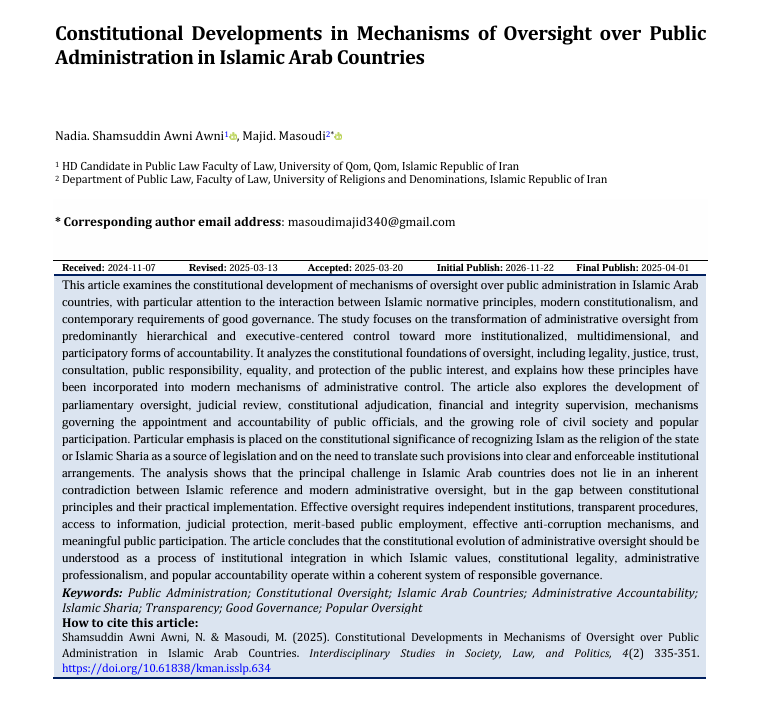
Constitutional Developments in Mechanisms of Oversight over Public Administration in Islamic Arab Countries
Keywords:
Public Administration, Constitutional Oversight, Islamic Arab Countries, Administrative Accountability, Islamic Sharia, Transparency, Good Governance, Popular OversightAbstract
This article examines the constitutional development of mechanisms of oversight over public administration in Islamic Arab countries, with particular attention to the interaction between Islamic normative principles, modern constitutionalism, and contemporary requirements of good governance. The study focuses on the transformation of administrative oversight from predominantly hierarchical and executive-centered control toward more institutionalized, multidimensional, and participatory forms of accountability. It analyzes the constitutional foundations of oversight, including legality, justice, trust, consultation, public responsibility, equality, and protection of the public interest, and explains how these principles have been incorporated into modern mechanisms of administrative control. The article also explores the development of parliamentary oversight, judicial review, constitutional adjudication, financial and integrity supervision, mechanisms governing the appointment and accountability of public officials, and the growing role of civil society and popular participation. Particular emphasis is placed on the constitutional significance of recognizing Islam as the religion of the state or Islamic Sharia as a source of legislation and on the need to translate such provisions into clear and enforceable institutional arrangements. The analysis shows that the principal challenge in Islamic Arab countries does not lie in an inherent contradiction between Islamic reference and modern administrative oversight, but in the gap between constitutional principles and their practical implementation. Effective oversight requires independent institutions, transparent procedures, access to information, judicial protection, merit-based public employment, effective anti-corruption mechanisms, and meaningful public participation. The article concludes that the constitutional evolution of administrative oversight should be understood as a process of institutional integration in which Islamic values, constitutional legality, administrative professionalism, and popular accountability operate within a coherent system of responsible governance.
Downloads
References
Abd Zaid, H. K. (2023). Human Rights in the Constitution and Islam. Journal of the Islamic University College(70).
Abdulsalam, A. Q. O. (2022). The Islamic Constitution: Its Concept, Emergence, Sources, and Characteristics—A Compilation and Study. International Journal of Islamic Sciences(4).
Al-Abbar, S. K. (2021). The Position of Sharia within Constitutional Provisions: Issues of Terminology and Application. Journal of Sharia and Legal Sciences(Special issue).
Al-Hasan, S. A. H. (2006). The Realism of Islamic Legislation. Huda al-Islam Journal(7).
Al-Jundi, A. H. (1983). Towards a Draft Islamic Constitution. Ninth Conference of the Islamic Research Academy,
Al-Misawi, M. a.-T. (2007). The Objectives of Sharia from New Perspectives. Al-Tajdid Journal(22).
Al-Nuwaini, A.-H. (2021). The Relationship between Religion and the State in Modern Arab Constitutions: A Comparative Study of the Moroccan and Tunisian Constitutions. Shu'un al-Awsat Journal(164).
Al-Othmani, S. a.-D. (2021). Legislation and Laws. Al-Munazara Journal(24–25).
Al-Shalash, M. M. S. (2018). Islamic Legislation and the Civil State: The Problem of the Relationship and the Debate over Terminology. Islamic Research Journal(30).
Al-Sharif, M. i. S. (2013). The Constitution and Sharia. Al-Bayan Journal(306).
Al-Sudairi, T. i. A. A. (1987). The Constitution in Islamic Countries and Its Problems in the Light of Islam [Master's thesis, Imam Muhammad ibn Saud Islamic University].
Aydin, M. A. (2008). The Relationship between Religion and Legislation and the Role of Codification Movements in This Relationship. The Development of Islamic Jurisprudential Sciences: Codification and Renewal in Contemporary Islamic Thought,
Bdeir, N., & Khalil, A. (2019). References to Islam and Sharia in Constitutional Documents and Their Impact on Religious Freedom: A Comparative Study.
Halliday, F. (2002). Islam and International Law: A Clash between Two Visions of Interests and Values in Relations among Nations. Al-Ijtihad Journal(54).
Hilal, A. a.-D. (2013). Comparative Experiences in the Constitution-Making Process. Al-Nahda Journal(1).
Jamal al-Din Atiya, M. (2012). Towards the Implementation of Islamic Sharia (1). Al-Muslim al-Mu'asir(143).
Mutawalli, M. A. (2014). The Ethical Theory of Governing Systems between Religion and Law. Journal of the Association of Arab Universities for Legal Studies and Research(35).
Wasfi, M. K. (1975). Islamic Sharia and the Rule of Law. Al-Muslim al-Mu'asir Journal(1–2).
Downloads
Additional Files
Publication Timeline
- Submitted
- Revised
- Accepted
Issue
Section
License
Copyright (c) 2025 Nadia Shamsuddin Awni Awni (Author); Majid Masoudi (Corresponding author)

This work is licensed under a Creative Commons Attribution-NonCommercial 4.0 International License.