The Role of Foreign Intelligence Organizations in Military and Paramilitary Incidents of the Islamic Republic of Iran
Keywords:
Intelligence, Espionage, Military and Paramilitary IncidentsAbstract
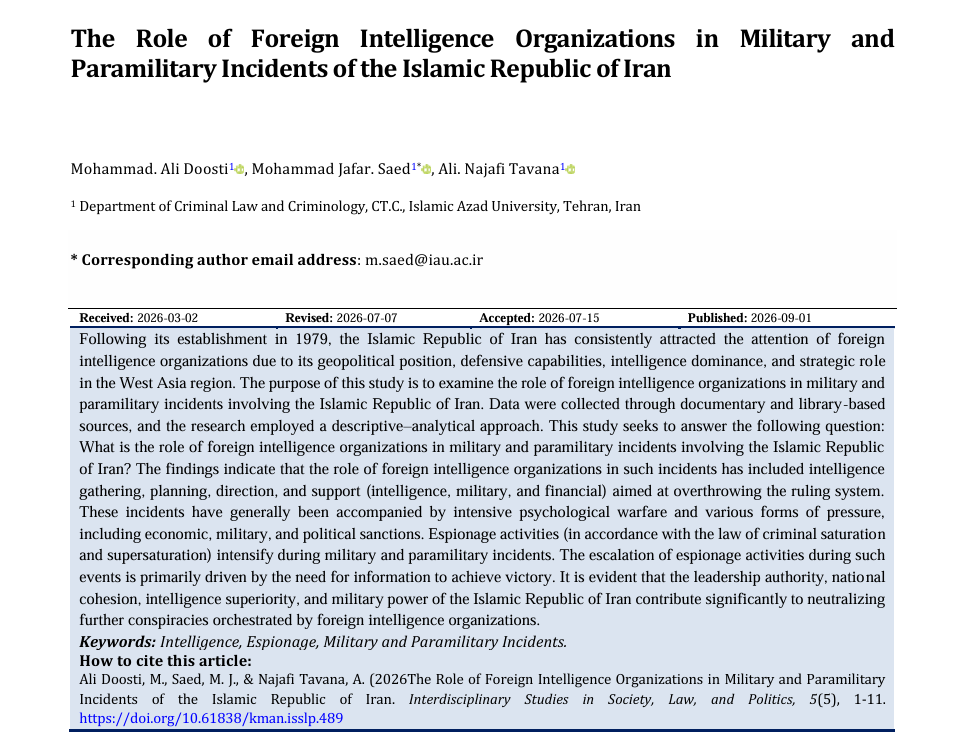
Following its establishment in 1979, the Islamic Republic of Iran has consistently attracted the attention of foreign intelligence organizations due to its geopolitical position, defensive capabilities, intelligence dominance, and strategic role in the West Asia region. The purpose of this study is to examine the role of foreign intelligence organizations in military and paramilitary incidents involving the Islamic Republic of Iran. Data were collected through documentary and library-based sources, and the research employed a descriptive–analytical approach. This study seeks to answer the following question: What is the role of foreign intelligence organizations in military and paramilitary incidents involving the Islamic Republic of Iran? The findings indicate that the role of foreign intelligence organizations in such incidents has included intelligence gathering, planning, direction, and support (intelligence, military, and financial) aimed at overthrowing the ruling system. These incidents have generally been accompanied by intensive psychological warfare and various forms of pressure, including economic, military, and political sanctions. Espionage activities (in accordance with the law of criminal saturation and supersaturation) intensify during military and paramilitary incidents. The escalation of espionage activities during such events is primarily driven by the need for information to achieve victory. It is evident that the leadership authority, national cohesion, intelligence superiority, and military power of the Islamic Republic of Iran contribute significantly to neutralizing further conspiracies orchestrated by foreign intelligence organizations.
Downloads
References
Abdollahi, M. (2011). Invisible Hands: An Analysis of Strategies and Leaders of Soft Subversion in Iran. Sahel Andisheh Iran Publications.
Adams, J. E. (1998). The New Spies (R. Deputy for & P. Knowledge, Trans.). National University of Intelligence and Security Press.
Alavi, M. S. (2000). A Study of Guerrilla Strategy in Iran, 1963-1979. Center for Islamic Revolution Documents Press.
Amid, H. (2012). Amid Dictionary (31st ed., Vol. 1). Amir Kabir Publications.
Asthana, N. C., & Nirmal, A. (2009). Information Management and Security (A. Pirhayati, Trans.). National University of Intelligence and Security Press.
Berkowitz, M., & Bock, P. G. (1996). Selected Political-Security Articles (R. Institute for Social, Trans.; Vol. 2). Binesh Publications.
Buzan, B. (1991). People, States and Fear: The National Security Problem in International Relations. University of North Carolina Press.
Clarridge, D. R. (2008). A Spy for All Seasons: My Life in the CIA (A. Amraei, Trans.). Ettelaat Publications.
Cooper, H. H., & Dellinger, L. (2001). Training Spies (R. Deputy for & P. Knowledge, Trans.). National University of Intelligence and Security Press.
Demarest, G. B. (1996). Espionage in International Law. Denver Journal of International Law & Policy, 24(2).
Eftekhari, A., & Naderi Asl, S. (2025). An Analytical Comparison of Protests in Iran, 2013-2023. National Security Quarterly, 15(55), 39-66. https://ns.sndu.ac.ir
Farahidi, K. i. A. (1988). Kitab al-Ayn (Vol. 2). Dar al-Hijrah Institute Publications.
Farsinejad, A. (2009). The Nojeh Coup. Ettelaat Newspaper Publishing Institute.
Fialka, J. J. (2002). Economic Espionage in America (R. Deputy for & P. Knowledge, Trans.). National University of Intelligence and Security Press.
Ghadre Velayat, C., & Artistic, I. (2012). The Mojahedin-e Khalq Organization. Ghadre Velayat Publications.
Gharib, M. (1987). Dictionary of Quranic Terms (Vol. 1). Bonyad Publications.
Goldouzian, I. (1990). Specific Criminal Law. University Jihad Publications.
Grey, S. (2018). New Spymasters: Inside the Modern World of Espionage from the Cold War to Global Terror (R. Deputy for & P. Knowledge, Trans.). National University of Intelligence and Security Press.
Herbig, K. L., & Wiskoff, M. F. (2015). American Citizens Spying against the United States (M. Abbasi, Trans.). Farabi Faculty of Science and Technology Press.
Herman, M. (2014). Intelligence Services and National Security: Intelligence Power in War (R. Deputy for & P. Knowledge, Trans.). National University of Intelligence and Security Press.
Jafari Langroudi, M. J. (2009). Comprehensive Legal Terminology. Ganj Danesh Publications.
Kavoshi, H. (2009). The Islamic Republican Party: Martyrs of the Islamic Republican Party (Vol. 3). Haft-e Tir Cultural Foundation Publications.
Khodaverdi, H. (2009). Iran-United States Relations from the Victory of the Islamic Revolution to the Seizure of the Espionage Den. Center for Islamic Revolution Documents Press.
Koushki, H. (2016). The Jundallah Terrorist Group. Fars News Agency Publications.
Laqueur, W. (2002). A World of Secrets (R. Deputy for & P. Knowledge, Trans.). National University of Intelligence and Security Press.
Lippmann, W. (1943). U.S. Foreign Policy: Shield of the Republic. Little, Brown and Company.
Lowenthal, M. M. (2002). Intelligence: From Secrets to Policy (2nd ed.). Congressional Quarterly Press.
Naeimi, N. (2020). The Organization of Toilers of Kurdistan Party of Iran: Komala. National University of Intelligence and Security Press.
Najafi Tavana, A. (2018). Criminology. Education and Assessment Publications.
Nourbaha, R. (1998). Foundations of Criminology. Ganj Danesh Publications.
Nutter, J. (2005). Black Operations of the Central Intelligence Agency: Covert Action, Foreign Policy, and Democracy (R. Deputy for & P. Knowledge, Trans.). National University of Intelligence and Security Press.
Rasa Monitoring Intelligence Organizations. (2025). Events of the Twelve-Day War.
Rowan, R. W. (1931). Espionage. Macmillan.
Saeedi, F., & Salehi, M. (2019). Fundamentals of Intelligence and Counterintelligence. National University of Intelligence and Security Press.
Sarikhani, A. (1999). Espionage and Treason against the Country. Islamic Propagation Publications Center.
Shulsky, A. (2002). Silent Warfare (R. Deputy for & P. Knowledge, Trans.). National University of Intelligence and Security Press.
Taheri, G. (2014). A Study of United States Foreign Policy toward the Islamic Revolution of Iran: With a Review of American Failures in Actions against the Islamic Revolution. Arna Publications.
Totounchian, S. (2010). In the Color of Sedition. Abnush Publications.
Treverton, G. F. (2011). Reshaping Intelligence in the Information Age (R. Deputy for & P. Knowledge, Trans.). National University of Intelligence and Security Press.
Turner, M. A. (2009). Why Secret Intelligence Fails (G. Bani Hashem, Trans.). National University of Intelligence and Security Press.
Watson, B. (1958). An Encyclopedia. Garland Publishing Inc.
Wolfers, A. (1952). National Security as an Ambiguous Symbol. Political Science Quarterly, 67(4), 482-502. https://doi.org/10.2307/2145138
Zandi, E. (2007). The Concept of Intelligence Assessment. National University of Intelligence and Security Press.
Downloads
Additional Files
Publication Timeline
- Submitted
- Revised
- Accepted
Issue
Section
License
Copyright (c) 2026 Mohammad Ali Doosti (Author); Mohammad Jafar Saed (Corresponding author); Ali Najafi Tavana (Author)

This work is licensed under a Creative Commons Attribution-NonCommercial 4.0 International License.