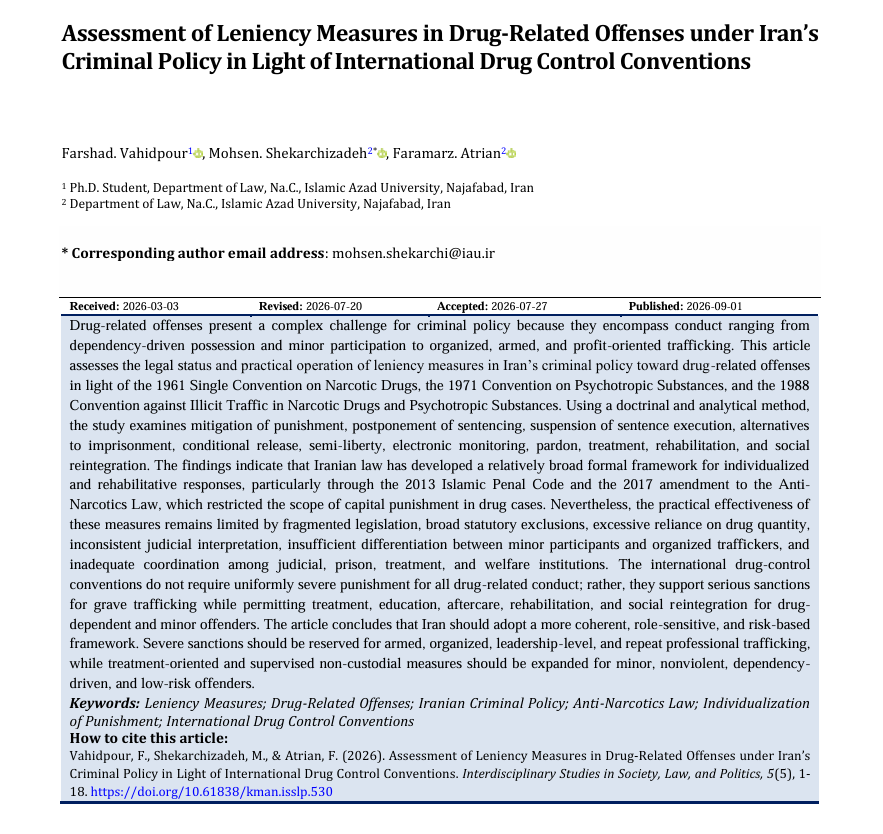
Assessment of Leniency Measures in Drug-Related Offenses under Iran’s Criminal Policy in Light of International Drug Control Conventions
Keywords:
Leniency Measures, Drug, Related Offenses, Iranian Criminal Policy, Anti, Narcotics Law, Individualization of Punishment, International Drug Control ConventionsAbstract
Drug-related offenses present a complex challenge for criminal policy because they encompass conduct ranging from dependency-driven possession and minor participation to organized, armed, and profit-oriented trafficking. This article assesses the legal status and practical operation of leniency measures in Iran’s criminal policy toward drug-related offenses in light of the 1961 Single Convention on Narcotic Drugs, the 1971 Convention on Psychotropic Substances, and the 1988 Convention against Illicit Traffic in Narcotic Drugs and Psychotropic Substances. Using a doctrinal and analytical method, the study examines mitigation of punishment, postponement of sentencing, suspension of sentence execution, alternatives to imprisonment, conditional release, semi-liberty, electronic monitoring, pardon, treatment, rehabilitation, and social reintegration. The findings indicate that Iranian law has developed a relatively broad formal framework for individualized and rehabilitative responses, particularly through the 2013 Islamic Penal Code and the 2017 amendment to the Anti-Narcotics Law, which restricted the scope of capital punishment in drug cases. Nevertheless, the practical effectiveness of these measures remains limited by fragmented legislation, broad statutory exclusions, excessive reliance on drug quantity, inconsistent judicial interpretation, insufficient differentiation between minor participants and organized traffickers, and inadequate coordination among judicial, prison, treatment, and welfare institutions. The international drug-control conventions do not require uniformly severe punishment for all drug-related conduct; rather, they support serious sanctions for grave trafficking while permitting treatment, education, aftercare, rehabilitation, and social reintegration for drug-dependent and minor offenders. The article concludes that Iran should adopt a more coherent, role-sensitive, and risk-based framework. Severe sanctions should be reserved for armed, organized, leadership-level, and repeat professional trafficking, while treatment-oriented and supervised non-custodial measures should be expanded for minor, nonviolent, dependency-driven, and low-risk offenders.
Downloads
References
Ardabili, M. A. (2017). General Criminal Law (Vol. 3). Mizan Publications.
Ashouri, M. (2018). Criminal Procedure. SAMT Publications.
Ghasemi, S., Abbasi, A., & Esmaeili, M. (2024). Foundations of Offender-Oriented Leniency Institutions in the Iranian Legal System. Comparative Research in Jurisprudence, Law, and Politics, 6(4), 81-99.
Goldouzian, I. (2019). Essentials of General Criminal Law. University of Tehran Press.
Khaleghi, A. (2010). Criminal Procedure (Vol. 2-3). Shahr-e Danesh Publications.
Khodakhah, N., Farajihah, M., & Sheikh al-Islami, A. (2026). Contextual Factors Influencing the Imposition of the Death Penalty in Drug Offenses. Comparative Research in Jurisprudence, Law, and Politics, 8(2).
Mani, N. (2008). Studies in Criminal Policy and Crime Control.
Moazenzadegan, H. (1990). Individualization of Punishments in Iranian Criminal Law. Journal of Legal Research.
Najafi Abrandabadi, A. H. (2005). Criminal Policy. Mizan Publications.
Najafi Tavana, A. (2004). Criminology. Majd Publications.
Nourbaha, R. (2001). Foundations of General Criminal Law. Dadgostar Publications.
Salimi, M., & Davari, M. (2002). Applied Criminology. Mizan Publications.
Solhchi, M. A., & Nasiri, S. (2018). The Death Penalty for Drug Offenses in the Iranian Legal System.
Zeraat, A. (2000). General Criminal Law. Qoqnoos Publications.
Downloads
Additional Files
Publication Timeline
- Submitted
- Revised
- Accepted
Issue
Section
License
Copyright (c) 2026 Farshad Vahidpour (Author); Mohsen Shekarchizadeh (Corresponding author); Faramarz Atrian (Author)

This work is licensed under a Creative Commons Attribution-NonCommercial 4.0 International License.