Challenges of Criminal Procedure in Emergency Conditions: A Critical Reflection on the Gap Between Norms and Reality in the Experience of the COVID-19 Pandemic
Keywords:
criminal procedure, state of emergency, COVID-19 pandemic, electronic proceedings, human rightsAbstract
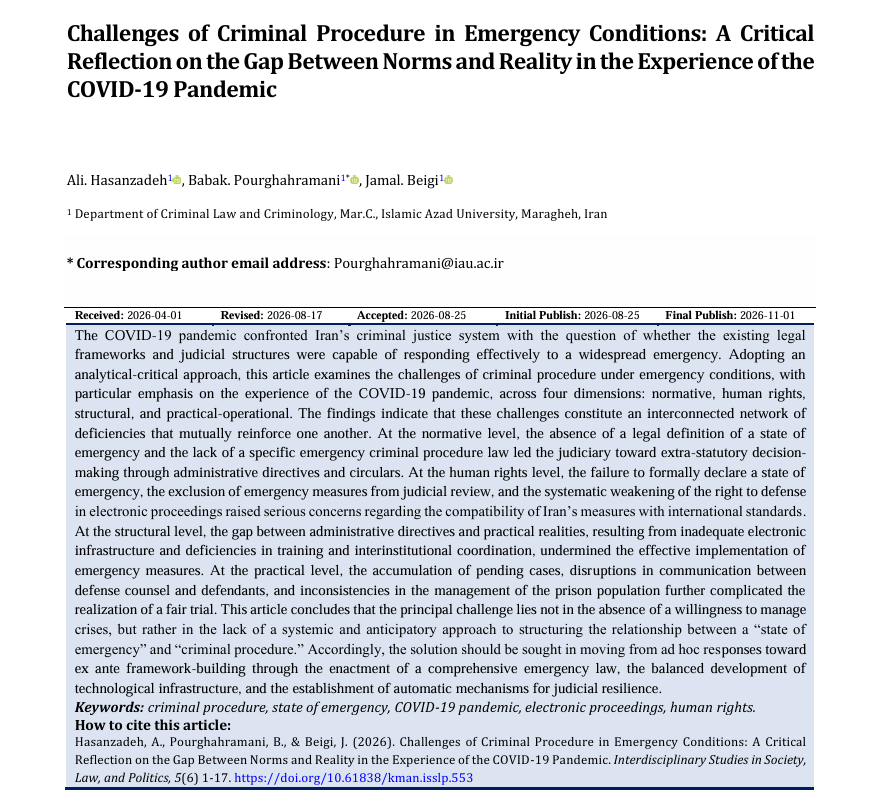
The COVID-19 pandemic confronted Iran’s criminal justice system with the question of whether the existing legal frameworks and judicial structures were capable of responding effectively to a widespread emergency. Adopting an analytical-critical approach, this article examines the challenges of criminal procedure under emergency conditions, with particular emphasis on the experience of the COVID-19 pandemic, across four dimensions: normative, human rights, structural, and practical-operational. The findings indicate that these challenges constitute an interconnected network of deficiencies that mutually reinforce one another. At the normative level, the absence of a legal definition of a state of emergency and the lack of a specific emergency criminal procedure law led the judiciary toward extra-statutory decision-making through administrative directives and circulars. At the human rights level, the failure to formally declare a state of emergency, the exclusion of emergency measures from judicial review, and the systematic weakening of the right to defense in electronic proceedings raised serious concerns regarding the compatibility of Iran’s measures with international standards. At the structural level, the gap between administrative directives and practical realities, resulting from inadequate electronic infrastructure and deficiencies in training and interinstitutional coordination, undermined the effective implementation of emergency measures. At the practical level, the accumulation of pending cases, disruptions in communication between defense counsel and defendants, and inconsistencies in the management of the prison population further complicated the realization of a fair trial. This article concludes that the principal challenge lies not in the absence of a willingness to manage crises, but rather in the lack of a systemic and anticipatory approach to structuring the relationship between a “state of emergency” and “criminal procedure.” Accordingly, the solution should be sought in moving from ad hoc responses toward ex ante framework-building through the enactment of a comprehensive emergency law, the balanced development of technological infrastructure, and the establishment of automatic mechanisms for judicial resilience.
Downloads
References
Aghababaei, H. (2021). A Comparative Study of Emergency Law with a View to COVID-19 Disease Management: From Legal Foundations to the Authorization of Criminal Intervention. Judiciary Law Journal, 85(116).
Aghaei Togh, M. (2020). Constitutional Requirements for Managing Emergency Situations with Emphasis on COVID-19. Legal Research Quarterly(2).
Bigzadeh, E., Gharedaghi Seyedfatemi, S. M., Mahmoudi, S. H., & Lotfian, M. H. (2020). The Coronavirus Problem in the Mirror of Contemporary International Law. Legal Research Quarterly.
Criddle, E. J. (2012). Human Rights, Emergencies and the Rule of Law. Human Rights Quarterly, 34(1).
Eghbali, K. (2021). The Role of the Judiciary in Supervising the Suspension of States' Human Rights Obligations. Judiciary Law Journal, 85(114).
Esmaeili, A., & Pourghahremani, B. (2019). Challenges Facing Electronic Proceedings in Iran. Quarterly Journal of Judicial Legal Perspectives, 24(87).
Feizollahi, N., Sartibi Zarnaq, M., Moghari, A., & Khalilollahi, M. (2024). Assessing the Possibility of the Judge's Inner Conviction in Electronic Proceedings. Scientific Quarterly of Interdisciplinary Studies of Law and Islamic Education, 1(2).
Garner, B. A. (2009). Black's Law Dictionary (9th ed.). West Publishing Co.
Ghamami, S. M. M. (2020). An Analytical Study of Models for Managing Emergencies Disruptive to Public Health: A Case Study of the Coronavirus Disease (COVID-19). Excellence of Law Quarterly, 11(2).
Ghorbannia, N. (2007). Suspension of the Implementation of Human Rights in Emergency Conditions. Jurisprudence and Law, 3(12).
Godfrey, B., Richardson, J. C., & Walklate, S. (2022). The Crisis in the Courts: Before and Beyond Covid. The British Journal of Criminology, 62(4).
Harisinejad, K., & Soleimani, M. (2015). Suspension of Rights and Freedoms in the Constitution of the Islamic Republic of Iran in Light of Human Rights Instruments. Islamic Law, 13(50).
Havener, S. (2014). Effects of Videoconferencing on Perception in the Courtroom Arizona State University].
Jalali, A., & Abuata, M. (2020). Emergency Status and Restrictions on Fundamental Rights: Examining the Italian Government's Measures to Confront the Coronavirus Disease. Public Law Research Quarterly, 22(67).
Mansourian, M., & Asakereh, Z. (2024). Drafting a Public Health Emergency Law: Assessing Necessity, Rules, and Criteria. Islamic Law, 21(81).
Mirkamali, S. A. (2020). The Impact of the Coronavirus on Criminal Proceedings: Opportunities and Challenges. Legal Research Quarterly(2).
Moazenzadegan, H., & Abedin Nistanak, A. (2023). Assessing the Feasibility of Investigating Judge Actions in the Electronic Proceedings Process. Judiciary Law Journal, 87(123).
Moazenzadegan, H., Mehra, N., & Rasteh, M. (2025). Validating Witness Testimony in the Context of Emerging Technologies: Challenges and Opportunities. Criminal law and Criminology Studies, 55(1).
Moazenzadegan, H., & Molabigi, A. (2022). A Legal-Jurisprudential Examination of Remote Testimony with Reference to the View of Branch One of the Tehran Province Criminal Court. Scientific Quarterly of Judicial Legal Perspectives, 62(94).
Moghaddasi, M. B., & Ghasemi, E. (2021). The Coronavirus Pandemic and Its Impact on Criminal Proceedings: A Comparative Study of France, Belgium, and Iran. Comparative Law Studies, 12(2).
Najjarzadeh Hanjani, M. (2020). A Legal Analysis of Restrictions Arising from the Coronavirus Pandemic in Iranian Law: In Search of the Competent Administrative Authority. Administrative Law, 7(23).
Navari, A. (2022). State Derogation from Human Rights Treaties in the Era of the Global COVID-19 Pandemic: From the Existing Legal Regime to Strategies for Achieving the Desired Situation. International Law Review(66).
Nemati, M., Habibzadeh, M. J., & Farajihā, M. (2024). Prison as Court: Electronic Trial of the Imprisoned Defendant. Criminal law doctrines, 21(28).
Nemati, M., Mehra, N., & Rasteh, M. (2025). Challenges Arising from the Use of Emerging Technologies in Holding Public Sessions of Iranian Criminal Courts. Biannual Scientific Journal of Emerging Technologies Law, 6(11).
Parvin, K., & Paknejad, A. (2021). A Legal Examination of the Entry of Armed Forces into Emergency Conditions Resulting from the Coronavirus Outbreak. Scientific Quarterly of Human Rights and Citizenship Research, 6(2).
Popelier, P., Kleizen, B., De Clerck, C., Glavina, M., & Van Dooren, W. (2021). The Role of Courts in Times of Crisis: A Matter of Trust, Legitimacy and Expertise.
Rabiei, A. (2008). Suspension of Rights Contained in Human Rights Treaties in Emergency Situations University of Tehran]. Tehran, Iran.
Rostami, H. (2023). The Collapse of Fair Criminal Procedure in Confronting Political and Social Crises. Scientific Quarterly of Criminal Law Research, 11(43).
Sharifi, M. (2020). Criminal Liability Arising from Transmission of the Coronavirus in the Iranian Criminal System: With Emphasis on Risks to Human Life. Criminal law doctrines, 17(19).
Sobhani Tabrizi, J. (1994). Al-Rasa'il al-Arba'. Imam Sadiq Institute.
Vajdani, E., Mohammadi, S., & Hosseini Moghadam, S. H. (2022). Challenges of Implementing Electronic Proceedings in Iranian Law from the Perspective of Fair Trial and the Rights of Litigants. University of Tehran Private Law Studies Quarterly, 52(1).
Wehmeier, S. (2004). Oxford Advanced Learner’s Dictionary. Oxford University Press.
Zamani, S. G., & Esfandiari, M. (2017). Suspension of the Implementation of International Human Rights Rules in Public Emergency Situations. Journal of Legal Research, 31(1).
Downloads
Additional Files
Publication Timeline
- Submitted
- Revised
- Accepted
Issue
Section
License
Copyright (c) 2025 Ali Hasanzadeh (Author); Babak Pourghahramani (Corresponding author); Jamal Beigi (Author)

This work is licensed under a Creative Commons Attribution-NonCommercial 4.0 International License.