Criteria for Distinguishing the Supplementation and Modification of Law in Government Rulemaking within the Iranian Legal System (The Scope of Government Rulemaking from the Perspective of Modifying and Supplementing the Law)
Keywords:
Supplementation of Law, Modification of Law, Government Rulemaking, Hierarchy of Legal Norms, Article 138 of the ConstitutionAbstract
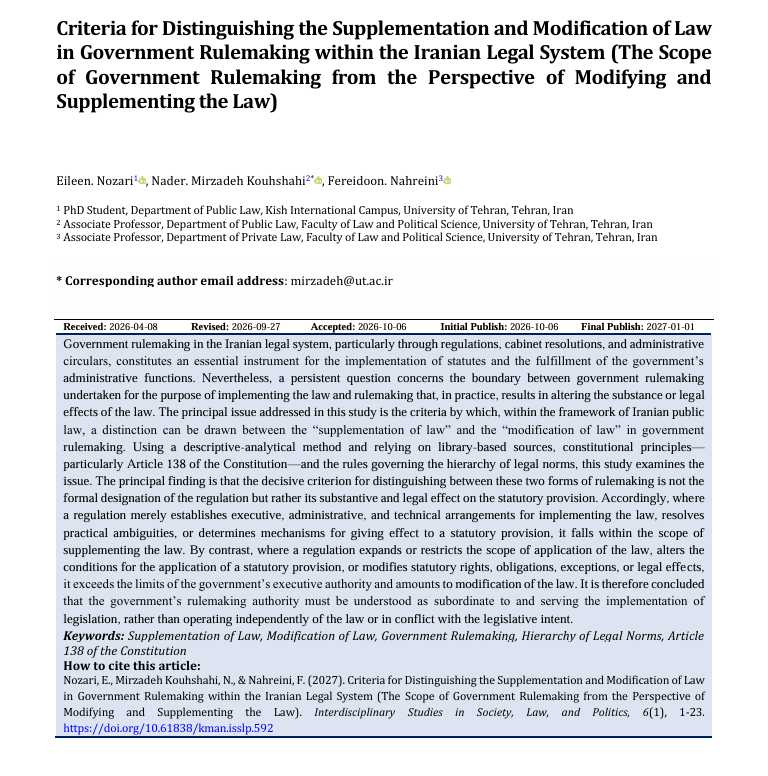
Government rulemaking in the Iranian legal system, particularly through regulations, cabinet resolutions, and administrative circulars, constitutes an essential instrument for the implementation of statutes and the fulfillment of the government’s administrative functions. Nevertheless, a persistent question concerns the boundary between government rulemaking undertaken for the purpose of implementing the law and rulemaking that, in practice, results in altering the substance or legal effects of the law. The principal issue addressed in this study is the criteria by which, within the framework of Iranian public law, a distinction can be drawn between the “supplementation of law” and the “modification of law” in government rulemaking. Using a descriptive-analytical method and relying on library-based sources, constitutional principles—particularly Article 138 of the Constitution—and the rules governing the hierarchy of legal norms, this study examines the issue. The principal finding is that the decisive criterion for distinguishing between these two forms of rulemaking is not the formal designation of the regulation but rather its substantive and legal effect on the statutory provision. Accordingly, where a regulation merely establishes executive, administrative, and technical arrangements for implementing the law, resolves practical ambiguities, or determines mechanisms for giving effect to a statutory provision, it falls within the scope of supplementing the law. By contrast, where a regulation expands or restricts the scope of application of the law, alters the conditions for the application of a statutory provision, or modifies statutory rights, obligations, exceptions, or legal effects, it exceeds the limits of the government’s executive authority and amounts to modification of the law. It is therefore concluded that the government’s rulemaking authority must be understood as subordinate to and serving the implementation of legislation, rather than operating independently of the law or in conflict with the legislative intent.
Downloads
References
Fadaei Jouybari, M., Taghizadeh, J., & Nejabatkhah, M. (2017). A Strategic Analysis of the Term 'Laws' in Article 138 of the Constitution of the Islamic Republic of Iran. Rahbord(82), 29-48.
Hadavand, M., & Jam, F. (2022). Redefining the Concept of Regulation: From a Centralized Approach to Decentralization. Administrative Law Quarterly, 10(33), 245-269.
Hashemi, S. M. (2019). Constitutional Law of the Islamic Republic of Iran (Vol. 2). Mizan Publishing.
Kadkhodaei, A., & Darvishvand, A. (2012). Oversight of Government Regulations: Articles 85 and 138 of the Constitution. Public Law Knowledge, 1(1), 93-111.
Katouzian, N. (2013). Introduction to the Science of Law and Study of the Iranian Legal System. Mizan Publishing.
Malakouti Hashjin, S. H. (2014). A Reflection on the Interpretation of the Principle of 'Exceeding the Limits of Legal Authority' in English and Iranian Administrative Law Doctrine. Islamic Law, 11(40).
Mazhari, H. (2018). Legal Effects Arising from the Distinction between Types of Competence in Public and Administrative Law. Payame Noor University Law Journal, 7(1), 99-111.
Mehrpour, H., & Alamolhoda, S. H. (2017). Analysis of the Possibility of the Administrative Justice Court Relying on the Constitution. Rahbord, 26(2, consecutive 83).
Mohseni, F., & Ghamami, S. M. M. (2013). Pathology of Inconsistencies in Government Approvals during Review by the Speaker of the Islamic Consultative Assembly: Concerning Articles 85 and 138 of the Constitution. Public Law Knowledge, 1(3).
Nahrini, F. (2021). Principles of Legal Competence in the Iranian Public Law System. Judiciary Law Quarterly, 45(3), 11-40.
Nahrini, F. (2023). Principles of Legal Competence. In Encyclopedia of Policymaking (pp. 124-142).
Nejabatkhah, M., & Faqih Larijani, F. (2020). Reconceptualizing the Meaning of Administrative Regulations and Rules with Emphasis on the Judicial Practice of the General Board of the Administrative Justice Court. Public Law Knowledge(27), 89-108.
Parvin, K., & Patfat, A. (2015). Limits of Legislative Oversight over Cabinet Resolutions with Emphasis on Articles 85 and 138 of the Constitution of the Islamic Republic of Iran. Public Law Studies, 45(1), 63-82.
Vaezi, S. M. (2010). A Comparative Study of the Authority to Enact Regulations with Emphasis on the Legal Systems of France and Iran. Biannual Journal of Comparative Law(18), 139-162.
Vaezi, S. M. (2023). The Concept and Function of Competence in Administrative Law. Public Law Research Journal, Allameh Tabataba'i University Campus.
Vijeh, M. R. (2008). A Reflection on the Hierarchy of Norms in the Legal System of the Islamic Republic of Iran. Rahbord, 16(4, consecutive 50).
Zarei, M. H., & Shams, E. (2013). An Introduction to the Concepts and Theories of Economic Regulation. Legal Research(62).
Downloads
Additional Files
Publication Timeline
- Submitted
- Revised
- Accepted
Issue
Section
License
Copyright (c) 2025 Eileen Nozari, Nader Mirzadeh Kouhshahi, Fereidoon Nahreini (Author)

This work is licensed under a Creative Commons Attribution-NonCommercial 4.0 International License.