Strategic Prioritization of Iran’s Geopolitical and Geoeconomic Capacities under Sanctions: Application of Multi-Criteria Decision-Making (MCDM) Techniques
Keywords:
Geopolitics, Geoeconomics, Economic Sanctions, Economic Resilience, SWOT, TOPSIS, Multi-Criteria Decision-Making, IranAbstract
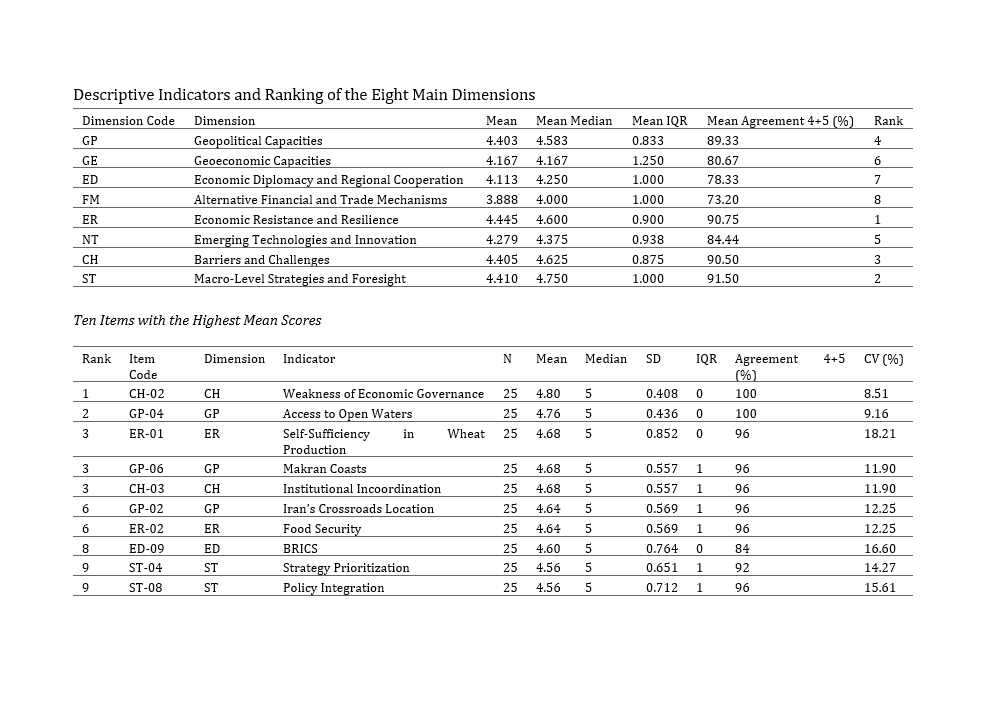
This study aimed to identify, evaluate, and strategically prioritize Iran’s geopolitical and geoeconomic capacities under sanctions and to rank the resulting strategic alternatives using expert assessment, SWOT analysis, and the TOPSIS multi-criteria decision-making technique. This applied quantitative study employed a descriptive-survey design. The statistical population consisted of experts in geopolitics, geoeconomics, economics, foreign trade, regional relations, energy, transportation, technology, and policymaking. Using purposive sampling, 25 experts participated in the study. Data were collected through a researcher-developed 80-item questionnaire covering eight dimensions: geopolitical capacities, geoeconomic capacities, economic diplomacy and regional cooperation, alternative financial and trade mechanisms, economic resistance and resilience, emerging technologies and innovation, barriers and challenges, and macro-level strategies and foresight. Responses were rated on a five-point Likert scale. Descriptive statistics, Cronbach’s alpha, the Friedman test, Kendall’s coefficient of concordance, SWOT analysis, and TOPSIS were used for data analysis. The Friedman test showed a statistically significant difference among the rankings of the eight dimensions (χ² = 33.75, df = 7, p = 0.000019). Kendall’s coefficient of concordance was 0.2009, indicating low-to-moderate agreement among experts. In the TOPSIS analysis, the highest-priority strategy was development of regional cooperation through Iran’s crossroads location (0.85), followed by strengthening transit corridors through the Makran coasts and southern ports (0.82), using Iran’s geopolitical position to reduce sanctions vulnerability (0.80), and using economic resilience to counter sanctions-related threats (0.78). The findings indicate that effective utilization of Iran’s geopolitical and geoeconomic capacities under sanctions requires an integrated strategy centered on economic resilience, institutional coordination, transit development, regional cooperation, governance reform, and technological adaptation. Combining domestic capabilities with external opportunities may enhance Iran’s strategic flexibility and reduce vulnerability to sanctions.
Downloads
References
Ahmadi, S., & Badiei, N. (2022). The Geopolitics of the Sea of Oman and Makran and Its Position in Iran's Maritime Development Strategy. Persian Gulf Strategic Studies, 8(29), 45-70.
Alavi, S. F., Taghizadeh, A., & Ghassabifard, M. J. (2025). A Comparative Study of Unilateral Sanctions and UN Security Council Sanctions: Legal Analysis and Extraterritorial Consequences. Legal Civilization, 8(23), 347-370.
Azimi, F., & Rezaei, M. (2020). Analysis of the Role of the Resistance Economy in Reducing Iran's Vulnerability to International Sanctions. Journal of Regional Economics and Development, 27(18), 85-110.
Bagheri, A., & Sabbaghian, A. (2024). U.S. Secondary Sanctions and the Strategy of European Companies' Withdrawal from Iran. International Political Economy Studies, 7(2), 12-50.
Bahramipour, F., Olfati, A., & Hazeri, N. (2023). Analysis of the Role of Secondary Sanctions in the European Union's Approach to the JCPOA (2015-2021). Global Politics Quarterly, 12, 7-37.
Dezhpasand, F., Yazdani, M., Taghavi, A., & Moridi Farimani, F. (2024). The Effects of Economic Sanctions on Iran's Oil and Gas Industry. Strategic studies in the oil and energy industry, 15(4), 80-125.
Eslami, M., & Naghdi, F. (2016). Sanctions as an Instrument of U.S. Foreign Policy toward Iran. Foreign Relations Quarterly, 8(4), 37-71.
Ezzati, A., & Veisi, H. (2006). A Geopolitical and Geoeconomic Analysis of the Iran-India Gas Pipeline. Iranian Geopolitics Quarterly, 2(2), 27-45.
Farrell, H., & Newman, A. L. (2023). Weaponized Interdependence: How Global Economic Networks Shape State Coercion. International Security, 44(1), 42-79.
Ghasemi, A., & Heydari, M. (2024). United States Economic Sanctions and Iran-China Geoeconomic Interactions. Foreign Relations Quarterly, 16(1), 25-60.
Hufbauer, G. C., Schott, J. J., Elliott, K. A., & Oegg, B. (2019). Economic Sanctions Reconsidered: History and Current Policy (4 ed.). Peterson Institute for International Economics.
Isaac, S. K., & Fouda, I. M. (2026). The Nexus between International Sanctions and Multilateral Negotiations: The Case of Iran's Nuclear Program. Review of Economics and Political Science, 11(2), 119-135.
Kaempfer, W. H., & Lowenberg, A. D. (2018). The Political Economy of Economic Sanctions: Theory and Evidence. Journal of Economic Literature, 56(2), 447-480.
Kantorowicz, J., & Kantorowicz-Reznichenko, E. (2026). Enhancing Public Support for International Sanctions: An Information Provision Experiment. Political Science Research and Methods, 14(1), 1-18.
Kenan, D. (2025). The Role of International Sanctions in Global Politics: A Case Study of Iran. SSRN Electronic Journal, 1-17.
Mearsheimer, J. J. (2021). The Liberal Delusion: Why Economic Interdependence Does Not Prevent Great Power Conflict. International Security, 45(3), 45-89.
Nephew, R. (2023). The Evolution of Iran Sanctions: From Comprehensive to Targeted and Beyond. The Washington Quarterly, 46(2), 87-104.
Rezaei, H., & Norouzi, F. (2024). Analysis of Barriers and Challenges to Utilizing Iran's Geopolitical Capacities under Sanctions. Defense Policy Quarterly, 32(125), 90-120.
Sadeghvand, B., Heydari, H., & Nejati, M. (2025). Welfare Consequences of Iran's Oil Sanctions: Application of a Dynamic Computable General Equilibrium Model. Economic Research and Policies, 33(113), 6-50.
Safari, M., & Mohammadi, S. (2023). The Role of the Shanghai Cooperation Organization in Reducing the Effects of International Sanctions against Iran. Asian Studies, 10(4), 110-135.
Shokri, M., & Farhadi, K. (2026). Examining the Impact of Economic Sanctions and Exchange Rate Fluctuations on Iran's Imports. Applied Theories of Economics, 13(1), 89-110.
Zamanianfar, L., Pakniat, Y., & Seraj, S. (2024). Strategies for Enhancing Resilience against Economic Sanctions on Iran as a Foreign Policy Instrument. Scientific Journal of Passive Defense, 15(2), 45-75.
Downloads
Additional Files
Publication Timeline
- Submitted
- Revised
- Accepted
Issue
Section
License
Copyright (c) 2025 Rasoul Afzali (Corresponding author); Marjan Badiee Azandahi, Ehsan Rahnama (Author)

This work is licensed under a Creative Commons Attribution-NonCommercial 4.0 International License.